THE BEAUTIFUL MONSTER- UN’S SUSTAINABLE DEVELOPMENT GOALS(SDGs) 

There I was, seated innocently and curiously listening to the ‘powerful’ and captivating speeches by the guest speakers. However, I was rather fuzzy, the speakers seems so deep down into the SDG’s (Sustainable Development Goals) ; was not sure either to be impressed or skeptical. Back at home, I hardly hear this topic being discussed in fact, most people do not even know what SDG’s is all about!

We had travelled hundreds of miles from Nairobi, Kenya to Arusha, Tanzania to represent the youths of Kenya in the Tanzania National Youth Assembly. The event which was aimed at engaging and equipping the youth with capacity building skills that promote Education for peace and Sustainable development, was organized by Vijana Assembly in partnership with UNESCO/MGIEP and the YESPeace Network.

Let’s be realist here folks, there is a probability that the person reading this has not come across SDG’s or has never taken or taken little interest in knowing what it is all about. This is despite the fact that most of the world’s activities are getting aligned with the SDG’s. But hey, this is your lucky day, I am going to give you a brief summery about SDG’s, just enough for basic knowledge. 

Below is an extract from UNITED NATIONS DEVELOPMENT PROGRAMME website on what SDG’s entails(I hope it will be helpful in making you digest this issue…):-

“The Sustainable Development Goals (SDGs), otherwise known as the Global Goals, is a universal call to action to end poverty, protect the planet and ensure that all people enjoy peace and prosperity.

These 17 Goals build on the successes of the Millennium Development Goals, while including new areas such as climate change, economic inequality, innovation, sustainable consumption, peace and justice, among other priorities. The goals are interconnected – often the key to success on one will involve tackling issues more commonly associated with another.

The SDG’s work in the spirit of partnership and pragmatism to make the right choices now to improve life, in a sustainable way, for future generations. It provide clear guidelines and targets for all countries to adopt in accordance with their own priorities and the environmental challenges of the world at large. The SDGs is an inclusive agenda. It tackle the root causes of poverty and unite us together to make a positive change for both people and planet. “Poverty eradication is at the heart of the 2030 Agenda, and so is the commitment to leave no-one behind,” UNDP Administrator Achim Steiner said. “The Agenda offers a unique opportunity to put the whole world on a more prosperous and sustainable development path. In many ways, it reflects what UNDP was created for.”

I think now were are on the same page, if not, feel free to read compressively on SDG’s for a wider and boarder understanding. One thing you’ll all agree to is that, SDG’s sounds fancy, flashy or rather overambitious. They look good in paper but the question is, are they achievable? Are they really inclusive as said? Are they really workable in developing countries? Are they realistic?

It’s everyone’s prayer and hope that SDG’s to be achieved as speculated, but they cannot and will not be achieved with business as usual.  These goals makes me feel nostalgic for MDGs (Millennium Development Goals). So why am I so skeptic about something that looks so beautiful?

For a start, it is important to note that core of the SDG’s programme for development and poverty reduction relies precisely on the old model of industrial growth. There is a big problem in this model since it not harmonizing rapid industrial growth with the commitment to hold global warming below the 2° Celsius threshold, and calls for “sustainable patterns of production and consumption.”  Goal 8 calls for 7% annual GDP growth in the least developed countries and higher levels of economic productivity across the board. At this rate, it is expected that the environment will feel the pinch. As you read, global production and consumption levels are overshooting our planet’s capacity by about 50% each year. Yet the SDG’s offer nothing but superficial responses: reduce food waste, make resource use more efficient, and “encourage companies to adopt sustainable practices.”  These proposals explicitly sidestep the only real solution, which is to reduce over-consumption by the World’s wealthy.

We are all familiar with the raise in GDP in our country, yet life seems to even get more difficult to the common citizen. In simple terms, such growths do not necessarily reduce poverty.  While global GDP has grown by 271% since 1990, the number of people living on less than $5 a day has increased by more than 370 million. This makes me question why SDGs rely on growth as a poverty-reduction strategy. It clearly doesn’t work! Is it because the prospect of growth allows our leaders to sidestep the challenge of having to distribute existing resources more fairly? According to statistics, on a best case scenario with this strategy it take about 207 years to eliminate poverty with this strategy. And to get there, we will have to grow the global economy by 175 times its present size.  This is obviously a terrible strategy: even if such immense growth were possible, it would drive climate change to catastrophic levels and, in the process, rapidly reverse any gains against poverty.

Has it is clear the growth is not in any way the solution to eradicating poverty. So what is it? One issue that SDG’s is openly ignoring is the widespread inequality. The silent speaks volumes and its deafening! Surprisingly, only real alternative is to reduce the enormous inequality that marks our global society, where the richest 1% own half of the world’s total private wealth. Yet SDG’s is not any way addressing this issue! It makes me question if Developing Countries really made a contribution to formulating these goals, because as it looks they had insignificant, little or no contribution since this would be the major agenda. It is important to note that, the SDG’s initially included two other targets on equitable sharing of global resources, but US negotiators eviscerated them last month in a last-minute backroom decision. Thus yet another monumental global challenge has been handed down to the next generation.  This betrayal is the subject of an open letter to the UN that has been signed by Noam Chomsky, Naomi Klein, Thomas Pogge, Chris Hedges, Eve Ensler and other powerful voices. It looks like rich and developed countries are protecting their interests at the expense of poor and developing countries in the name of SDG’s. What’s the sanity in all these?

Poverty, poverty, poverty! Is what we as a society has been trying to eradicated. It all started with MDGs and know SDG’s. Ironically, SDG’s offer little solution on the known global drivers of poverty! Makes me question why we even have the goals if they can’t address the major issues. They say nothing about the unfair trade regime of the World Trade Organization, or the many bilateral trade and investment agreements that liberalize global markets at the expense of the poor. In fact, instead of tackling this crucial issue, Goal 17 subjection 10 calls for more trade liberalization and more power for the WTO. And instead of demanding an end to the financial speculation that has caused food prices to spike since 2007, pushing 150 million into hunger, the SDG’s ask that we “ensure the proper functioning of food commodity markets.” It’s not clear what this means, but it can easily be interpreted as yet more liberalization, which is what caused the food crisis in the first place. They refuse to call for debt cancellation even though debt service drains developing countries of more than $700 billion per year – money that could be directed instead toward poverty reduction.  On the contrary, clauses inserted by the EU in yet another backroom deal ensure that borrowers shoulder full responsibility for over-indebtedness. This are just but few examples, SDG’s will not end poverty until it tackles real issues.

In the SDG’s proposal to end extreme poverty, it is evident that they are still stalk to measuring poverty level at only $1.25/day! This is despite of the fact that a growing number of scholar have and are pointing out that $1.25/day is not adequate for human subsistence. A number of recent studies suggest that if people are to achieve normal life expectancy and meet their basic needs as outlined in the Universal Declaration of Human Rights, they need closer to $5 per day. So having the measurement at $1.25/day will give a miss-measurement of poverty levels, giving the false pretext that we are achieving the goals yet we are not even close. If we measure poverty by the more accurate $5/day line, the total poverty headcount rises to 4.3 billion people, more than 60% of humanity. This is alarming. What’s is SDG’s really addressing?

The SDG’s aim to leave no one behind! That is very sad because poor and developing countries will even be far much behind by 2030 when the goals expires, what then?! It would be a waste of several years trying to chase fancy ideas only favoring a few rich countries. For African and other developing countries, we need real and realistic programme, policies and strategies to develop our countries least we remain in the same state. During the first UN summit on SDG’s in New York (2015), a quote by Ban Ki Moon- “Some 8.5 million people have made their voice heard to the United Nations” — left me perplex, who are these 8.5 million people because last time I remember we (developing countries) have little or no influence on the j of SDG’s yet it’s made to look like it focus on “them”.Sad!

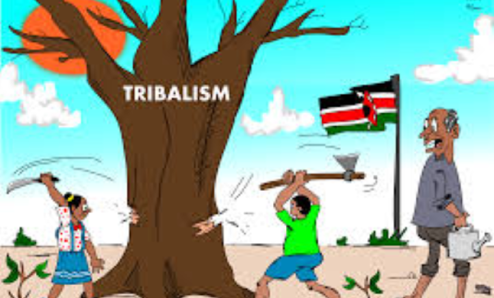
Negative Ethnicity- “A divided Nation”

He couldn’t brush off the feeling, was he anxious, scared or just paranoid? Honestly I can’t tell, but one thing I am sure of, is that his stomach felt like it turned upside down. Even with several people around him, he felt lost and lonely. Throughout the seemingly heartful conversation in the matatu, he couldn’t understand a thing a part from occasionally hearing the names of famous politicians and specific ethnic communities mentioned. Judging from the current state of affairs in our dear country Kenya, he was determined on hiding his ethnic background due to the fear of being negatively profiled or ‘worse’. When he had to pick a phone call, he was left with two choices; pick but speak in Swahili or English (not foolproof due to his strong ascent), or just ignore the call all together to avoid unnecessary attention. The second option was the best, in fact pretending to be asleep throughout the entire journey was an innovative idea- just in case one of the passengers tried to engage in a conversation with him.
How did we reach here? A situation where you are insecure in your own country! An era where it is not an option to freely express yourself with ease! A country where most citizens are afraid to travel, stay or speak their ethnic languages in parts of the country they are not ‘affiliated’ to! A state where your character and behavior is judged and determined by ethnical stereotyping! A time where your chances of successes are correlated to your ethical background! A society where some cultural practices are considered superior to others! A nation where intelligences, wisdom and knowledge can be link to certain ethnic communities’ rite of passage! A democracy where some people are more equal than others! This is a broken nation where love, peace and unity are just experienced in writings not in real life. Last time I remember, this was Kenya but it’s hard to tell now! So as we always put it, where did the rain start beating us?

Elections has been a good platform for Kenyans to hide on unleashing their tribal rivalry. They hide under political parties and their ideologies to practice negative ethnicity. I find this to be so sickening, because even my educated brother and sister from both the Agikuyu, Kalenjin, Luo, Luhya… mention others, are in the fore front in doing this. You will of course notice through their twitter and Facebook posts. They are also confident enough to even do it in public, where they will openly discriminate, insult, catalysis conflict at times be part of the conflict. This is clearly the elite in our society. Education has impacted no value in them.

Negative ethnicity informs and guides our politics, religions, business, thinking and what we talk either on social media or on our everyday interactions. I am just here yearning and advocating for the time that Kenyans will be ethnically sober and STOP embracing the demon of negative ethnicity.

My apologies, my bad. I forgot to define the term negative ethnicity, this is the hate of people based on ethnical or tribal difference. It is the rejection of humanity and leadership from other ethnic groups. Its purpose is not self-preservation but rather discrimination and demonization of others.

Negative ethnicity is the most potent weapon of mass self-destruction in Africa. Just in the past 4 months in Kenya, it has claimed a significant number of lives. This because of utterly hatred that it comes with it. Kenyans regard tribal differences as enemies and traitors. 

It is recorded that since Independence of African states, Negative ethnicity has killed over 10.8 million people. Ethnic genocide killed approximately 1 million people in Rwanda, 2 million in Sudan, 2 million in Biafran war in Nigeria, over 2.5 million in Democratic of Congo, 20,000 in South Africa, 100,000 in Algeria, over 1 million in Somalia 200,000 in Burundi, 1 million in Angola, 800,000 in Uganda, 150,000 in Liberia, 50,000 in Sierra Leone and over 1300 in Kenya. Comparatively, atomic bomb killed 100,000 people in Hiroshima and 40,000 in Nagasaki.

I was surprised the other day when I read a post of a friend on Social media, that this ethnical violence are stage managed, and it is not reality.  Is this what I should refer as denial of the practice? Are we waiting for the Kenyan case to explode as it did in 2008 South Sudan case or even the 1994 Rwandan genocide? Just the other week when I was on my field work, I came across a group of Young men, they seem to be at their 30s, they were condemning one of the Kenyan tribe and even swore to kill them. I was so frightened, scared and disappointed, this is the extent of the hatred Kenya has based on ethnic difference. 

Un-knowingly this is how negative ethnicity escalates to ethnic wars. It first wins hearts and minds of the people becoming the ideology of the communities, politics, parties and elections. Second, it works closely with the Machiavellian principle of “the end justifies the means”: If negative ethnicity will give you job, power, land, money, tender or even business, why not practice it. Third, negative ethnicity reserves all positions of leadership to only their tribal alienation. Under the notion that all good leaders come from their tribe and all the other bad leaders come from the other ethnic group. Fourth, it takes government captive and uses it to unleash ethnic mayhem. Once the government has embraced it, it only destroy and never develop the people and the country. Fifth is that, negative ethnicity is a key protector of corruption, which in turn uses resources for self-perpetuation. 

Our differences should not be a source of discrimination and intolerance but a source of strength, beauty and pride. We need to curb ethnicity, no generation needs this. Mamur Mustapha puts it, “we’ve rigged the entire system of living in harmony with nature against ourselves. We raise our children and inculcate various “isms” into them. They in turn perpetuate it by passing the same (if not more) onto their’s. We raise slaves, not independent thinker.”

imprint of global immigration

An alien, that’s now your legal name, a term you grew up knowing it only referred to those ugly extraterrestrial creatures with ill motive of destroying or conquering the world, at least that’s what Hollywood taught you. How did you get here? There is always a captivating story behind every single immigrant.

Meet Kasir (not his real name) who has been forced to flee his country due to political instability which has claimed the life of his parents and siblings. He is only 16 years old and had to trek hundreds of miles with limited food and water to get into a refugee camp in a neighboring country. What does the future hold for Kasir now that everything is seems all lost to him? Kasir’s story is not unique as this has been the case in Rwanda, S.Sudan and it’s the norm in the Middle East.

The grass is always greener on the other side, at least that’s according to Lilian (not her real name). The promise of a greener pasture drove her off her country. She has already conformed to the trends and culture of her host country. I wonder if she like it here, and does she live the life she anticipated? Immigrants in such for better economic empowerment in other countries are found in many countries all over the world.

Then comes Fatuma (not her real name), she has been staying in a foreign country for three years now. This is all in the name of better education and exposure. She believes that this is the best opportunity for her to pursue and advance in her education, better than she would have done back home. Who wouldn’t wish to secure a chance in a prestigious university a broad? Many like Fatuma leave their county to quench their thirst for knowledge in other countries.

Demographic factors, economic disparities and environmental changes are the major drivers of migration: This is a mixed migration flows. It consist, refugees, asylum seekers, regular and irregular migrants. Migration has both positive and negative impact to us and our society. Negative migration involves human trafficking, kidnapping of vulnerable refugees and migrants, torture, abuse of female refugees  and migrants, a shrinking protection space for refugees and migrants dying  while crossing the Sahara desert to Libya, the Gulf of Aden in Yemen, or the Mediterranean Sea to Italy. Positive migration can be effective in poverty reduction strategy and has many beneficial effects for countries of origin, destination countries and for migrants themselves.

Migrants fill gaps in labor markets, send billions of remittances to their countries of origin, pay taxes, and stimulate trade and transfer technologies skills and ideas. People from the poorest places gaining the most. International migration reduces poverty at the family level. International migration positively contribute to human capital formation, migrant remittances multiplier effects in rural economies and can thus contribute to economic development. Education and healthcare receive high priority in the spending of remittances.

In the United States of America, evidence suggests that immigration leads to more innovation, a better educated workforce, grater occupational specialization, better matching of skills with jobs, and higher overall economic productivity. Immigrates have kept the level of innovation high in this country judging from the fact that in the last decade several multibillion dollar companies from Tesla to Pfizer have been founded by immigrants.

Japanese reluctant to accept immigrants (apart from very highly skilled personnel) seems to take a toll on its economy. Its economy to recession,  and maybe immigration into the country might just be the solution. Japanese population have been shrinking,  translating to fewer workers,  fewer consumers, and less overall demand, all while a growing elderly population puts strain on government budget. A fresh influx of labor force into the country may save the economy by providing increased labor (both skilled and Non-skilled) to supplement the already depleted labor force,  and to also improve the innovative new of the Japanese people through acquisition of knew knowledge and skills. 

Public perception seems less convinced on the positive effects of migration. Anti-migration is common in them. What has led to this the negative rhetoric that is often used in media coverage and comments on migration. Some of the unsubstantiated myths on social and security risks of migrants include; migrants migration imports ethnic tension, migrants are potential terrorists or pose health risks to the society, refugees and migrants are disproportionately involved in criminal activities.

Despite the fallacy spread by both main stream media and social media that immigrants in the United States of America are the reason for high level of insecurity and terrorism in America, research has it otherwise. According to Nowrasteh’s   analysis, over the past 41 years (from 1975-2015; the chance an American would be killed by a foreign-born refugee terrorists is 1 in 3.64 billion per year; the chance of an American being murdered by undocumented immigrant terrorist is 1 in 10.9 billion per year; the chance of an American could be killed by a terrorist on a typical tourist visa was 1 in 3.9 billion. This is to include the fact that there hasn’t been a single American killed by terrorist from one of the seven countries (Iran, Iraq, Libya, Somalia, Sudan, Syria, and Yemen) includes in the President’s travel ban.

Immigration has been the major driver of advancements and civilization for millennia. The movement of people from one place to another, has led to the sharing of ideas and knowledge which has been integral in human survival and improved lifestyle. Just as Lyndon B. Johnson quoted in regards to America’s Greatness—“The land flourished because it was fed from so many sources-because it was nourished by many cultures and traditions and people.”— is an indicator of the importance of immigration to the society.

The True Path to Peace

What is peace? In simple terms, it is freedom from disturbance; tranquillity. Therefore, the quietness one experiences while concentrating on a test or just relaxing on the warm sand in Watamu beach, all qualify as peace. My mum’s response when I asked her about what peace really is, changed my entire view of peace. She said that peace has many definitions. One definition of peace is the end of violence. Another definition of peace is to never use violence to show your emotions. She also asked me if I have ever thought of peace as an effective weapon against violence.

In a country or state, Peace is a term that most commonly refers to an absence of aggression, violence, conflict or hostility. However, Peace isn’t necessarily the absence of conflict but rather the presence of justice, and the ability to handle conflict in a peaceful means. Despite the occasional arguments, misunderstandings or disagreement we always experience in our families, most of us consider being with our families very peaceful.  In a society, peace happens when different desires are in one agreement. Peace is based on many things, culture, education, family values, experience, and history (to name a few) but the basis is the same–to co-exist without war, killing, & overpowering a fellow being.

According to me, Peace is the feeling that all’s right with the world. When everyone around me in my family, my friend circle and my neighbourhood are happy, eager to love, accept and relate… I feel at peace. Also, to me it means following what my heart says and sharing mutual trust and respect for people around me. The willingness to solve our conflicts, and not only be tolerant but also appreciate one another’s difference, is peace.

However, in today’s world, peace and harmony face various threats. Terrorism, regional imbalance, economic disparity, and social inequality are some of the factors which threaten peace today. Solving these issues is the key to a peaceful society, otherwise just preaching peace without real action is like playing a guitar to a wild goat expecting it to dance to your tune, it wouldn’t work. We all are so engrossed in our busy lifestyles and yet want our lives to be peaceful. We expect that peace to be omnipresent but what we need to realize is the fact that if we want peace- we have to live peacefully, love everyone, forgive, forget, etc.

It’s not enough to stand around asking if world peace will ever happen, because that won’t make any impact. Actions speak louder than words. If everyone starts living peaceful, in loving way, things will change. But someone has to start and lead by example. Mahatma Gandhi once said “You must be the change you wish to see in the world.”

We can’t rely on anyone else to do this. We have to do these ourselves. It all begins with respect for self and your neighbour. Being selfless is a good progress, don’t stand your neighbour going hungry, sick or with no shelter. Creating equal opportunities for everyone and at the same time being equitable is a good progress towards a peaceful coexistence. The moment free, transparent, fair and credible processes are compromised, then peace will not prevail however aggressive we may try to advocate for it.

Acceptance, compassion, and tolerance are the foundation of peace.

Mahatma Gandhi showed that peace ends suffering and oppression, not by warring against an enemy but by bearing witness to wrongs and allowing sympathy and common humanity to do their patient work. Nelson Mandela and Mother Teresa lived different aspects of peace, which was proven to be a viable way to achieve great things. It is possible to have a fake or plastic peace in a society, the dangers of this is that it is bound to fail because the anger, hatred and grief hidden deep down in the people is like a petrol bomb, just waiting for an ignition to explode, the aftermath will be catastrophic. So it’s important to own our past however dark it way be and not burry it, so as to learn and prevent a repeat of such vices. And also factor in accepting and solving the past injustices. This is the only way to achieve real reconciliation and a path to peace. Let’s not live under a pretext of peace which is not sustainable and healthyssss.

“When the power of love overcomes the love of power, the world will know peace.” Jimi Hendrix: Think about it.

TRANSATLANTIC SLAVE TRADE: THE AFRICAN REGRESS.

SLAVE TRADE 2

In my previous post I mentioned that divide of Africa might not be the cause of Africa misfortune. This has kept me thinking what the causes are/ were. “Can Slave trade be one of the major causes of this misfortune?” I wonder.

In 2015, I was privileged to work with an organization known as HAART Kenya, whose main purpose is working to end human trafficking in Kenya. They refer to it as Modern Slave trade (story for another day). Over the period there, I was exposed to what slavery is and what impact it has in our society.

The Trans-Atlantic slave trade radically impaired Africa’s potential to develop economically and maintain its social and political stability. Why do I say so? This exchange triggered a continuous process of exploitation of Africa’s human resources, labor, and commodities. This exploitative commerce influenced the African political and religious aristocracies, the warrior classes and the biracial elite, who made small gains from the slave trade, to participate in the oppression of their own people.

Way back in the 15th to 19th Century, All of us were not born. Our history records, Young energetic men, children and beautiful women being taken away by force to Europe. In exchange of few goodies for the selfish. Just the act of self-interest and greed by few individuals, led to the impaired-ness we are currently facing.

At least 12 million African men, women and children were forcefully transported in bondage to the Americas, within a three and a half century period. This was the trans-Atlantic slave trade which represented one of the longest and most sustained assaults on the very life, integrity, and dignity of human beings in history. This is due to the fact that the slave trade was brutal and horrific, and the enslavement of Africans was cruel, exploitative, and dehumanizing. The trans-Atlantic slave trade laid the foundation for modern capitalism, generating immense wealth for business enterprises in America and Europe. While the trade was contributing to the industrialization of northwestern Europe and creation of a single Atlantic world that included western Europe, western Africa, the Caribbean islands, and the mainland’s of North and South America, it left Africa bleeding and broken.

The mid seventeenth century marked the climax of the slave trade, which was at its most intense phase. This was as a result of the creation of ever-larger sugar plantations and the introduction of other crops such as indigo, rice, tobacco, coffee, cocoa, and cotton in the Americas.  This large plantations needed a lot of labor which could not be sustained by the few slaves and the natives, therefore, salves in large numbers were acquired and taken to Americas. Some slave traders – often well-respected men in their communities – made fortunes for themselves and their descendants. The corresponding impact on Africa was intensified as larger parts of west and central Africa came into the slavers’ orbit.

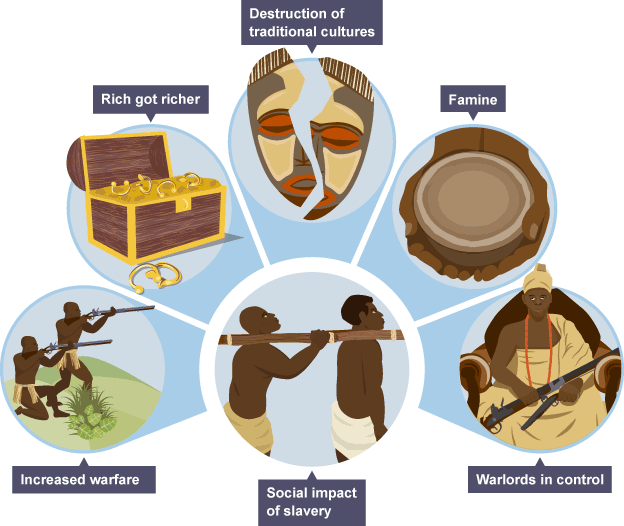
Trans-Atlantic slave trade caused a heartbreaking and detrimental effect to the Africans—the mere fact that Africans were raiding their fellow Africans, to capture them as slaves, and forcefully hand them over to European slave colonies in form of trade—This sad vice lead to ethnic fragmentation of Africans. Hostility among neighboring villages, communities and states escalated since they raided each other, capturing men, women and children to trade as slaves in exchange for arms and other commodities. The previously established codes of conduct (concerning warfare)–meant to create peace– were abolished, heightening levels of insecurity. Social interaction was highly compromised following high levels of insecurity among various social groups, and this led to confinement of populations within their respective ethnic boundaries and groups. Due to the rising incidences of conflicts, suspicion and banditry, arising from trans-Atlantic slave trade, there was destruction of almost all the village networks and federations, that had been created before, in the 19th century (Curtin 198).

 We are all very familiar with the consequences of insecurity, it causes fear, an emotion which must be acted upon. The high demand for slaves by the European colonies exerted lots of pressure on the African communities, thus leading to conflicts and even catastrophic war among these communities.  As a result, African States were weakened and fragmented. These African communities had to protect themselves from attacks by other communities, thus resorted to arming themselves with weapons available that time like knives, swords, firearms and spears. The only complication was that these weapons could only be acquired from the European colonies, and through the exchange of slaves! Yeah! You get the picture. The only way to arm and protect yourselves from attacks from neighboring communities was to attack your neighboring communities to capture slaves, and trade them for weapons! Everything seemed wrong with this, defending evil with evil leading to more evil! This escalated slave trade and created much more hatred between African states, due to the act of enslaving one another for security and protection. One good example in the 19th century was the Kabre community of Togo; which engaged in delivering of their own kin to European colonies in exchange of iron knives, and spears for defense (Curtin 184).

What followed was political instability, it’s pretty simple, what would the weakening and fragmentation of African States result into? If you think this time fell short of conspiracies and evil plots which would only be possible in the modern times, you are wrong. Europeans with their Africa partners intentionally caused political instabilities in most African states for their own benefits. They participated in intervention of various political processes so as to create internal instabilities and conflicts as this translated into more slaves for them. The raiders and merchants of slavery formed alliances with various groups in villages and States purposely to get slaves. Since most of the community young men were frustrated by the fact that power was under control of elderly men, they readily made alliances with these merchants to extract slaves. This actually led to increased political instability, internal conflicts and ultimate weakening of the States. Most of the pre-existing forms of government collapsed due to internal conflicts and increased political instability. For instance, the weakening of political institutions domestically occurred within the West Central Africa’s Kongo Kingdom, where the local Kongo citizens were kidnapped in early 1514, and handed over or sold to Portuguese slave merchants. This scenario became rampant with time and created lots of social and political disorder, leading to collapse of the entire Kingdom and the King’s authority (Curtin 198).

Criminals were good news to the slave merchants since they automatically qualified as easy take as slaves without a break of sweat. For this reason therefore, they resorted to using false accusations against individuals for community crimes like the dreaded witchcraft to criminalize many individuals. Majority of African communities had a well-established judicial and punishment penalties for such crimes at this time. However, these merchants took advantage of this system to convert the penalties into enslavement. Examples of some converted penalties included but not limed to: ex-communication from the community, beatings, compensation, and exile (Nunn 153). As a result, those who were falsely accused automatically become enslavement candidates. This practices subsequently resulted into deterioration of the established legal institutions due to abuse of the judicial system, with leaders supporting this tribute to protect their communities and themselves. A good example was the Cassanga chief, who engaged in punishing the community members by giving them poison. Those who took the poison and vomited were pronounced guilty and immediately sold to slavery merchants. For those that failed to vomit, they actually faced death due to poisoning. Their family members, who had remained behind, were then manipulated, seized of any available property and handed over to slavery merchants for shipping. It is these kinds of acts that led to total deterioration of the legal systems, which had been put in place prior to occurrence of the trans-Atlantic slave trade (Nunn 167).

What would you do if you are living in a place close to where dangerous criminal dealings occur? The most logical act is to move away as far as possible due to the fear of being a victim of their criminal activities. This is exactly what most African communities opted for, fleeing. The slave merchants had various distinct routes which they used to transport the slaves they had raided and capture to the coast, where they were gathered, branded and shipped. Majority of communities, which were living along these particular routes, were forced to migrated and flee for the sake of their safety since they were vulnerable to attacks. This unwanted displacement of these communities subsequently resulted into abandonment of various activities, projects and investment opportunities. People had to abandon their lands and farming activities, this impacted agriculture to a great margin as an economic activity. This led to DE-stabilization of many economies of the Africa States during the entire period of the slave trade (Engerman 64). 

 Trans-Atlantic slave trade was the black plague to Africans. What good could possibly come out of a practice which involved humans treated worse than animals? Many Africans met their deaths due to this slave trade in the course of its entire period. Impacts of slave trade like conflicts, inter-ethic fragmentation, political unrest, and other forms of disorder, led to many killings, which saw many innocent Africans, lose their lives. A part from those who were killed during raids and wars in pursuit for slaves, many more Africans, who were captured and transported to the coast for shipping also died on the way due to ruthless handling, merciless beating, and excessive use of force. The colonies inside Africa also started fighting against each other over slaves, thus leading to massive killings. It is these massive killings that led to stagnation of the population of Africa, nearly for the entire period of 19th century (Engerman 87).

Frequent raids, conflicts and displacements caused be trans-Atlantic led to loss of lots of property. In some cases an entire village was torched to the ground by raiders and people held captive leading to loss of millions worth of properties. In fact, those who were raided and captured had their property destroyed, or taken away, by other powerful members of the society, without seeking permission or clarification from the immediate family members (Whatley 82).

Summing up all the above effects of trans-Atlantic slave trade, they all contributed to a grand effect. Economic development in most of the African States stagnated due to these effects of slave trade, this was majorly due the fact that quit a number of African human resource was lost slave trade. Human resource is the most importance resource when it comes to production and development of economy. Some states thrived in wealth amassed from slave trade which become a lucrative economic activities which also led to dependence on European goods, since other economic activities become unpopular or even abandoned. When slave trade was finally banned by Britain and United States, the African states which thrived on slaves collapsed and become vulnerable to conquest and colonization. The Europeans firearms fueled war and instability which continued to this day.

Trans-Atlantic slave trade was a contributor to the racism ideology. Most African slavery had no deeper reasons than legal punishment or tribal warfare. But the Europeans who preached a universal religion of Christianity, who were against enslavement of fellow Christians, needed a justification for a practice which was obviously against their beliefs and ideology of equality. So in order to justify the enslavement of the Africans, they claimed that Africans were biologically inferior and were destined to be slaves. For this reason therefore slavery in Americas attained a racial basis, thus making it impossible for the slaves and their future descendants to gain equal status in the society.

In conclusion, it is obvious that Trans-Atlantic trade is likely to be one of the major causes of African misfortune that I have indicated above. The question now is, what should we do to rectify this damage which trickles down to date?

SLAVE TRADE 1

Ramification of Modern Terrorism

Majority of us have witnessed it over the TV or Internet at the safety and comfort of our warm cozy homes. Regardless of how bad the situation is, we can’t really empathize enough to understand what’s really going on. The chills and the feeling of our stomachs turning are only periodical, soon we forget and go to bed with smiles on our faces. But the reality is still upon those men, women and children directly affected. The scenes of demolished buildings and cars is nothing compared to the horrific view of lifeless bodies of people swimming in pools of blood scattered all over the place. In some cases, the body is completely vaporized with no remains at all. Fathers, mothers, brothers, sisters, uncles and aunties or an entire families is vanquished. The survivors are left with two choices, either to flee or remain and face the devil. This is what modern terrorism has evolved to, something so ugly I luck words to fully describe.

Terrorism! What is really terrorism? It is not as straight forward to define as you may think, besides most of us haven’t really reflected deeply on this issue. Popularly, terrorism is described as use or threatened use of force against civilians designed to bring about political or social change. However, while we think of terrorism as being both a political and irrational act, terrorism can also be thought of as a rational act conducted specifically because of the impact — fear, confusion, submission — it will have. 

To make it more complex, according to both the Department of Defense (DOD) and the FBI, terrorism is “the unlawful use of force or violence against persons or property to intimidate or coerce a government, the civilian population or any segment thereof, in furtherance of political or social objectives.” The DOD definition adds that a goal of terrorism can be “inculcating fear” (thus the psychological dimension), while the State Department is more elaborate, specifying that terrorism may include the use of biological, chemical or nuclear devices as well as the act of “assassination.” Implication of this is that, should the assassination of Osama bin Laden, the use of Nuclear weapons on Japan and chemical weapons on Vietnam during World War II also be classified as terrorism?

The complexity of such a question is brought about by our moral compass and obviously our biasness. This is the grand conundrum of defining terrorism; it is very difficult to separate it from acts of war, just or unjust. We all have heard the saying, “One man’s terrorist is another man’s freedom fighter.” Remember the Mau-Mau–Kenya– fighter were considered terrorist by British colonialist whereas, the native Kenyans regarded them as freedom fighters. Remember that in 1980s, Osama bin Laden and his comrades were branded as freedom fighters by American government whereas, during the same period the likes of Dick Cheney considered Nelson Mandela–South Africa– a terrorist. Does it make any sense to you now that terrorism seems to be all about the angle at which you view the act? This is dangerous!

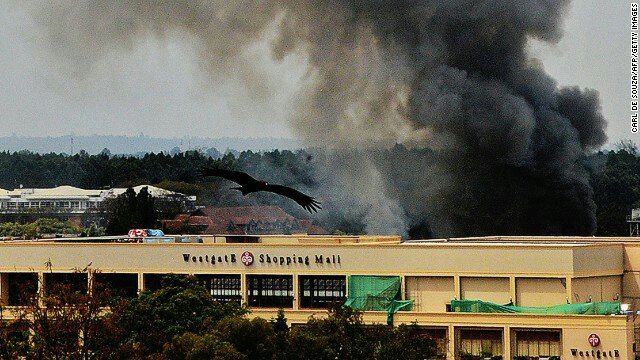
How did we get here in the first place? Why the anger and hatred towards fellow humankind compelling us to plot and execute evil schemes against one another? There must but a root to this evil. People have their reasons, Mau-Mau fighters wanted their land back and Mandela was fighting against apartheid rule. Why would Al-Shabaab attack Westgate, Nairobi killing at least 67 people, and later attack Garissa University College, Kenya keeping hostage and killing students, not to mention Mpeketoni attacks? Why is it that some Middle East Arab countries are continuously at war and why would they want to  attack western countries? Such organize acts are not just done randomly and without reason.

Borrowing from Washington State University publication on Roots of Modern Terrorism in the Middle East, published on January 18, 2015 by Calvin McClain, it is not paranoid to conclude that western imperialism is the major contributor to the modern terrorism. We might be in denial but the truth is wide open for all of us to see. The act of European imperialist trying to westernize the Middle East and its citizens and the creation of territorial boundaries across Middle East, has been the root of terrorism coming from Middle East in many decades. The fight for oil and other resources played a small part as well. But one of the most important aspect of this imperialism according to McClain was the creation of Israel following World War II. These people turned to their radical ways because they were frustrated with European imperialism and what was tied with it.

How will you react if someone invaded your home forcing you to conform to his/her own way of life? During the era of European expansion, the Muslim society became discontent with Europeans push for westernization in Muslim homeland, also, following the industrial era the need for oil round the world was astounding and European nation sought to take advantage of the Middle East oil. Many writers and historians agree to this. The European’s quest to imperialize the Middle East has had strong connection to radical terrorism. According to McCain, these people were being forced to change their way of life and become a “civilized” group of people, which seems to be a common goal of Europeans during any of their eras of expansion into foreign lands. After the discovery of the abundance of oil in the Middle East, western Europeans industries came fast and did not stop to look at the destruction they were causing to the Muslim society.

These industries partnered  with some Middle East hierarchy like Abd al-Aziz lbn Saud in the early 1900’s. But were ran by Europeans and no respect for Muslim workers. What began as frustrated workers rioting would turn to a frustrated society where some individuals and small groups would take radical measures to achieve their goals. Most of these western nations and Soviet Russian were quick to turn to military action because of the negative connotation of the Middle East people also known as Orientalism– a way of seeing that images, emphasizes, exaggerates and distorts difference of Arab people and culture as compared to European and the U.S. (it often involves seeing Arab culture as exotic, backward, uncivilized, and at times dangerous). 

Creation of Israel as a state and enforcing security measures in the borders restricting entry, has been frustrating to Muslim due to the fact that Israel is in the heart of the Muslim holy land. This has been a source of religious and political conflicts for decades, some of the Muslim people believed that they were being wronged or treated unfairly, especially concerning the holy land. This hatred is cemented by the fact that creation of Israeli borders by the Jewish after World War II was backed by western nations like the United States of America.

The imperialized laid the foundation for modern terrorism after which several terror groups with personal interests started springing up. Religious was used as fuel, terror sects used brainwashing techniques to recruit people into the sects with promises of reward from higher powers. They also used forceful means like kidnapping and holding hostage family members of a person they intended to use a suicide bomber. Young kids were and are still the most effective assets for the terror groups, not only do they look innocent and thus can penetrate and deliver a package into an enemies’ zone, but also gullible and can easily be duped and trick (some are made to believe that the explosives will not harm them since they explode outwards thus willingly take the role of suicide bombers). They also use human shields as a tactic to slow and confuse their enemies before they attack suddenly. 

Currently there are several terror groups which have sprung up all over the world, but without a reasonable doubt there are a few outstanding ones. To begin with The Islamic State of Iraq and the Levant (ISIL, ISIS or simply the Islamic State) — the world most dangerous organized terror group which has attracted the attention of every single country in the world– According to CIA, it has approximately 31,000 fighters. They captured Mosul– the second largest city in Iraq– swiftly and with ease. ISIS has single handedly swept across Middle East controlling an area the size of Belgium. They have achieve this by employing the most brutal and imaginable techniques that even Al Qaeda could not easily accomplish– rounding up and executing anyone who shows the slightest bit of resistance to its domination– At least four cases of mass killings by ISIS terrorists have been documented, including the execution of 250 Syrian troops in August after the group captured the al-Tabqa air base. Not long ago, over 200 Iraqi tribesmen were massacred west of Ramadi in what can only be described as an attempt by ISIS to extinguish any competitor, however passive, who dares to rise up and challenge its authority. They also get a revenue of about $1 million a day on sale of Crude oil. But to who do they sell to?

Boko Haram– a jihadist group in northeastern Nigeria– has killed at least 6,742 people since May 2011 according to The Council on Foreign Relations. They use brutal tactics of razing villages down to the ground, head shots and burning their victims alive. What caught the attention of the international community was when they raided and held captive over 300 school girls of a boarding school in the Nigerian border town of Chibok, threatening them with forced marriage and forced conversion. This group is at war with the Nigerian’s National government, but for what reasons? Then comes Al-Shabab, a Salafist jihadi organization operating in East Africa, predominantly in Somalia. The group is the reason for instability in Somalia, they control a large part of Somalia and continuously attacts and kill people in the Somali government control regions. They have staged attacks in Kenya resulting into several deaths and also involved in kidnapping of both Kenyan citizens and foreign tourists. They are alleged to be funded by powerful people and also involve piracy along the Indian Ocean coast and in illegal smuggling of goods across neighboring countries’ boarders.

Other terror groups like Abu Sayyaf Group Filipino jihadist, Tehrik-e Taliban Pakistan, Tahrir al-Sham (formerly Al-Nusra Front) formerly affiliated to al-Qaeda and Hizballah or Hezbollah of Lebanon, are currently causing terror in their respective countries resulting into deaths of very many people and shuttered dreams of the many locals. They are increasingly acquiring high power weapons capable of causing serious damages, which are surprisingly manufactured in Western countries and the U.S. The question is, who is arming these militia groups and for what reason? Remember according to reports, The U.S. remains the lead arms supplier and patron of the Saudi regime, and was close to Pakistan during the Afghan war, while the dictator Zia ul-Haq (one of the world’s more ruthless) was in power. The CIA was a main funnel of over $3 billion in funds to the Afghan resistance, which became the core of the current terrorist network. The Soviet Union was likewise a supporter of the previous generation of Arab terrorists, such as Abu Nidal, the Popular Front for the Liberation of Palestine and other Palestinian groups.

Just as I mentioned earlier, Terrorism is getting complex. The case of Russian government bombing a market full of civilians including children in Aleppo Syria is an act of terrorism in the eyes of the Syrians. Such careless actions are the contributors of radicalization, the individual affected by such attracts will be vulnerable to manipulation by terror groups due to their emotional breakdown and the urge to seek justice or revenge. So, has the fight of terrorism with terror yielded positive results or has it worsen the situation over the years? Be the judge.

Solving a complex problem like terrorism calls for rationalism. It is important to understand the roots of this menace and surgically eliminate it instead applying remedies which will only make the situation worse over time. Terrorism is a threat and disrespect to humankind and should be treated with a lot of caution since it is also a double edge sword. Countries which were once beautiful like Iraq, Syria and Afghanistan have turned into real hell on earth, they are death traps. Peaceful countries like Kenya, Canada, U.S, France, and England among many others are continuously on the high alert due these terror groups which cause lots of injuries and deaths of their citizens. Respect for humankind is paramount in the war against terrorism. Terrorism is quickly getting out of hand regardless of the point of view you perceive it, something revolutionary must be done and quick, now that fighting fire with fire is not working as expected.  

Taking the advice of Dean Ornish, “… in an era in which war and terrorism– at home and abroad– are often based on racial, religious and ethnic differences, rediscovering the wisdom of love and compassion may help us increase our survival at a time when increasingly divided country and world so badly need it.” We need more than weapons to stop terrorism!

The Growing Economic Inequality

They are woken up by a strong foul smell, amplified by the poorly ventilated tiny single room house, the sewer is overflowing into the house, not again! But this is the least of their worry, the daily challenge is to at least provide one meal a day for the family of five, regardless of the ugly face of unemployment. Accessing clean drinking water here is a struggle not to mention using of washroom is a luxury. This is just a glance of what life at Kibera can be. Just a few kilometres away, the remains of the previous night’s delicious supper has to be disposed off to create room for fresh ones. The hot weather is an indication that the kids will find it necessary to cool off in the huge swimming pool filled with crystal clear clean chlorinated water. They don’t have to do any house chores because the two house helps got the 4-bedroom mansion covered. The life in Karen is all comfy. The disparity between the two neighbouring place is too bold to ignore. This is the state of the nation.

The gap between the poor and the rich has stretched to its widest levels since time immemorial. Economic inequality also referred to as the gap between the poor and the rich, wealth disparity or income inequality consists of the differences in the income and wealth distribution. Typically the term, the gap between the poor and the rich refers to inequality among groups and individuals in the society. The gap between the poor and the rich is related to the concept of equity: opportunity equality and outcome equality. 

This is something that is not visible to the majority. The pace of productivity growth is rising in my country (Kenya) and also in other African countries. However it is only lifting fewer boats. This growth is only enjoyed by the haves but not the have-nots. The rich or the wealthy are becoming richer and the poor, poorer…Why is this the case? Yet the national economy is recorded to have improved greatly. According to the IMF and World Bank reports, Kenya has seen a significant economic growth, the question is, has life gotten any better for the common citizens?

The major factors that we can identify that has contributed to the growing gap include; poor governance, no political good will, poor policymaking and implementation, leaders, culture, education, inadequacy of the elite role, globalization, labour markets, policy, taxes reforms, technological changes, un-employment, ethnicity, nepotism, racism, gender, inequality in salaries and wages, high taxes, exposure, adamant on adapting to life changes, lack of information among others.

It seems bizarre, that we, the so called “modern, intelligent and advanced civilization” are yet succeeded in solving the disparity between the poor and the rich. We are enslaved by the above mentioned factors, the irony of a civilized society. Will we ever transcend greed?

Our Leaders are known to be rich, only in very few instances if not none that a poor person is elected or nominated as a leader. We choose leaders who do not understand our problems, what is the plea or needs of the common “Mwanainchi”. We elect a leader whose interest is addressing the needs of his fellow class. Majority of our leaders use their position to enrich themselves, protect their interests and those of their colleagues, creating policies to protect their wealth and make them even wealthier.  Until we finally accept and appoint leaders who truly and genuinely have their citizens’ interests at heart, then that is the time we will start reducing this gap.

Our government has been taking loans around the world. For this reason therefor, high taxes are imposed on the citizens to pay these loans. Increasing taxes on daily today basic commodities has made them very expensive to purchase. The increase in cost of living result into the poor becoming even poorer. The government should resort to a sustainable model borrowing and also effectively utilize our own resources. The loans taken should also be properly utilized in activities and projects which are wealth creating by promoting socio-economic activities in the country. Huge sum of loan money is lost through corruption thus increase in tax burden is without any thing worthy to show for. Countries like United Arab Emirates are doing better economically, because of zero tax in most of their products.

Unfair distribution of resources is a norm in our country. Regions like North Eastern register almost zero development rates. How do we expect such regions to perform economically? It is obvious that they will not develop economy if they are not allocated enough resource to match their demands. At times we are fooled with bogus projects (poor infrastructure) like substandard roads and bridges like Sigiri bridge in Budalangi which collapsed even before being in operation. Such rip-offs of public funds contribute to increase in poverty levels.

Our education system standards in not completive enough in the current market. It focus so much on exams scores and grades rather than knowledge and important skills acquired. This has led to poor productivity, because we are not trained to practice but drilled to impress. Which is only reflected on the papers but not in the real field. We are not given the exposure required for people to be creative and inventive enough to meet the demand of the standard set in the global market. Majority to not get the chance to nature their entrepreneurial skills necessary to start business and creation of wealth in the society. Those who enjoy such exposures are the rich, who are taken to the best schools. Where they are offered the best when it comes to education and opportunities.

Tribalism, nepotism and racism bring about discrimination and favours. Job opportunities are given based on relations instead of merit. These vices cuts a lot of people out, who end up either unemployment or underemployed. The rich families tend give jobs, contracts and opportunities amongst themselves to keep the wealth within the families, regardless of competency levels. For such reasons therefor, the less privileged regardless of their skills will be most likely discriminated against. As per the Kenyan norm, getting a job means you must know somebody of influence or know somebody who knows somebody of influence, then you’ll get the job without following the right channels; interviews become a formality not a necessity.

We have insisted on cultures which do not give equal opportunity to all in terms of empowerment. Females are restricted on what they are supposed to engage in. Educating a single woman means educating the entire community, this is due to the great influence a woman can have in her community if empowered. Denying women equal opportunities lead to untapped potentials hence reduced productivity. The conservative nature of some people in various Communities such as the Maasai, Samburu, Pokot,  Luo among others, are adamant on adapting to new ways of life and economic activities which are competitive in the current market, away from the traditional techniques of pastoralism and fishing for instance. It is important to be innovative and employ the modern technologies to improve our living standards. Unlike a few people in these communities who are able to explore different ventures and opportunities for economic empowerment. We are raised in such a manner that we limit the establishment of the balance between personal growth and community growth. We concentrate more on developing the community and forget about our own personal development. Hence we end up less or not economically empowered..

Politics has direct influence in the economic statues of a country. This begins with poor and unsustainable policymaking by the government with little or no national economic impact. Misplaced proprieties by the government to invest on projects of less importance rather than investing in sectors like agriculture, health, manufacturing and IT which have a great impact on the economy. Poor governance leads to misappropriation and mismanagement of public resources which would have otherwise been used to improve living standards. These vices have manifested themselves in County governments, which was initiated to bring about devolution. Devolved government was to bring government services and resources closer to the common citizen, but what it has brought instead is corruption closer to the people. The chain of corruption and cartels has exponentially increased with devolution, more public resources are being embezzled. The devolved governance which was meant to alleviate poverty is doing the exact opposite, increase poverty at the benefit of a few individuals.  

The rich and wealthy people are secluding themselves, they are limiting themselves to the number of people they mentor. Transfer of knowledge is important in continuity of expertise in the society. Successful business people, competitive lawyers, engineers, diplomats, doctors, teachers, politicians and many others, should take it upon themselves to support and mentor young professionals which is important for national development. Strive Masiyiwa, a London based Zimbabwean businessman, entrepreneur, and philanthropist, the founder and chairman of global telecommunications group Econet Wireless and Kwese Sports, is known for mentoring and supporting (financial and moral support) innovators in his home country with the objective of improving living standards and eradication of  poverty.

Judging from the statements of Henry George, American Political Economist, ‘’ No person, I think, ever saw a herd of buffalo, of which a few were fat and the great majority lean. No person ever saw a flock of birds, of which two or three were swimming in grease, and the others all skins and bone.’’ Shows that the wealth disparity is a human creation, ironically the most advanced and civilized organism in the planet, yet driven by greed. I am compelled to believe that we really do not understand what being advanced and civilized means, we should learn from the animals.
             

Democracy- The Illusion of Choice


My head up, eyes closed as I breathe gently while a calming cold breeze massages my face. The sense of freedom is overwhelming here, a strange experience I must say. The feeling of the well-formed grains of the white sandy beach pressing against my feet is tickly. I slowly open my eyes to gaze at the vastness of the ocean complimented by a crystal clear blue sky, they are inseparable beauty. Everything seems to be in harmony here, the animals are in synch with the beautiful environment as the Sun smiles down upon the land. This island offer solitude away from all the negativity humanity has created, I am in full control of my actions and behavior here. Unfortunately, all these are just in my head, a mere lucid imaginations! I would have wished for staying in an island free from the influence of societal evil, but everlasting solitude is physically and emotionally strenuous because we are social creatures, besides I cannot afford an Island right now, so I am stuck to this life. A life where the common people have little or no say, a life where large corporates influence and manipulate every angle of our life, a life where a few politicians makes rules for their own interests and gains, a life where your sweat benefits a few, a life where you’ll be faced with huge suctions for standing for the truth, and a life I would gladly give up on with the slightest opportunity.

Democracy is defined as the Government for the people by the people and of the people. ‘The people” being the majority. According to its definition, it gives power to the people to choose leaders and how our nation is governed. However this is not the case, politics is not about 99 percent of us but is about the 1 percent who controls everything in it. Our democracy is a sham. We have no say in the factors which most affect our future. Democracy is frustrated by a process which could just as effectively be decided by a coin toss. 

There is a vicious cycle in our society that involves two things: money and power. Those in powerful positions either have money, or people with money put the person they want to have power in power. The illusion of democracy makes us feel like we put them there, or that we even want them there. We have been deceived into believing there is democracy. We are naïve not to realize how we are being manipulated by the 1%.  The sad truth is that rich and powerful corporates directly influence your state of life by implanting or paying off that leader you think you elected, to push agendas for their own benefit. Tobacco industries which gives us cancer, soft drink industries which makes us fat and diabetic, fast food industries which literally fed us with slow poison to mention just but a few, have in the past and present paid off politicians to make bills to allow them to continue killing us as they make huge profits. This is paramount in a ‘The moat Liberal and Democratic’ country like US.

Some few days I was watching some movie, I think most movie lovers have watched… “Now you see me now you don’t”. This movie is about magic. The characters in it are using conjuring trick that makes people believe in magic, yet in the real sense, they are manipulated. Everything is planned, they just take advantage of their naivety. Such is the similar concept with our democracy. We are duped into believing that we are democratic. My question is; how many agrees to the huge loans taken by the ‘government’ burdening tax payers? Who benefits from multibillion government tenders? Who really benefits from bilateral and unilateral trades? Who are the real beneficiaries of government subsidiaries? Why are you paid so little wages yet your company swims in profits? When was the last time your voice was heard? Why did you really vote for that particular politician, did you really have an option? Do you fall for the side shows of the politicians used to divert attention from real issues? Are you in full control of your life or in autopilot? 

 At least we think… 

“Screw the popular vote, and who has the most support from the majority.” That is what they say. Our political leaders are appointed… NOTE, I said appointed not ELECTED. I hope you did get me right? Or let me further explain, we are made to believe that we elected them, yet in the actual sense, they are appointed by certain individuals in our society. This is by selecting the person who will continue to line the pockets of the rich, the person who will toe the line for “big Pharma,” “Big Oil,” or whatever lobby group that paid enough money to shape the regulations or lack thereof that rule their industry. It is not about the political parties vying for political leadership, it is about money feeding power and power feeding money.

I was debating with a friend of mine on the need to vote. My take was, there is no need for me to vote. My argument was it is a waste time. But why? This is because, of the above mentioned reasons. My vote do not count anyway, so why should I bother. “This should change,” I convince myself. Why then should you vote when the elections are already predetermined? You might not realize it, but the reality is that popular or people’s favorite Politian is pocketed by the real people who rule the country behind the curtains. Paranoid? You might think!

This voting thing we so proudly take part in is about as useful as dangling keys if front of a crying baby, it shuts us up; it pacifies us. We are being lied to. The powerful people want nothing to do with democracy. You see, the problem with dangling keys in front of a crying baby is eventually the baby gets tired of the keys and starts crying again. In the long run, you are going to have to deal with the reason why the baby is crying, not just the act of crying.

In the end, the voices from down below are no longer going to be pacified by illusion of democracy and we will demand it. This has happened before, but the amplified ideology from viewing deck overpowers the ideology of rising from below where the rest of us reside. It is happening right now, we have candidates who are using their platform to advance a revolution, but they are being stonewalled at every turn and blacked out by mainstream media. The ones who stand to lose, the ones who have shook us down, and the ones who fueled the illusion of democracy are drowning their ideology out. 

It is time to stand up for democracy. We the people have been told that our voice matters, therefore we the people need to make our voices heard. We can no longer stand idly by waiting for something to change when it is clear that it’s not going to. We cannot keep thinking that the blue team is any different than the red team because they are not. Democracy is the common people’s rule, the power is in the people not the few manipulative individual using oppression to tame the people. Until we realize the truth that we are the source of power, there won’t be change.

These guys vying for political seats, majority if not all of them are all the same. Marked with greed for power. Fooling us that they have our society’s interest at heart. They are just lying to us by coming up with good policies that they do not fulfill when they get the leadership. All we need is a true government that is marked by actions that explain that it is indeed a government of the people, for the people and by the people. 

Our democracy has been hijacked for a long time, all electoral freedoms in our society are over so long as it’s controlled by selfish corporations. We should not allow these streets to be taken over by the selfish ‘rich’. Because it’s all of us who have built this nation, and we can tear it down unless they give us what we need.  A country like Switzerland is in the act of making this a reality. Its citizens can challenge a law passed by parliament with a referendum. You might just be thinking of your own Island now!

Let us Wake up!

THE HIDDEN FACE OF PLASTIC BAN

Traditional-Basket.jpg_350x350SHOSH BASKET

…She is seated under a Croton tree with a traditional stool “orindi”. With her is “othith” sisal and dried water hyacinth that she had collected from Lake Victoria few weeks ago. The sisal and hyacinths are colored in variety of shades. She is half way making a “kiondo” or “okapu” (basket). I am seated next to her on “par” (carpet or mat made from reeds), trying to emulate what she is doing. Beside us, there are three beautiful baskets that my grandmother had already completed.  I must admit, I love them. But this is not the case for a lot of youths, in fact, “kiondo” is uncool and meant for grandmothers, ‘‘shosho,” they say.  Some people also dislike it because of inconvenience, they find it bulky to carry along.

Traditional kiondo, non-woven bags, biodegradable plastic-look-alike bags, woolen paper bags and papyrus baskets, envelopes, and paper bags are the alternatives Kenyan has for the plastic bags. Indeed, Kenya is adjusting to life without plastic bags after a strict ban on the carriers. This is a good move, I must admit. But how good is good? I ask myself.

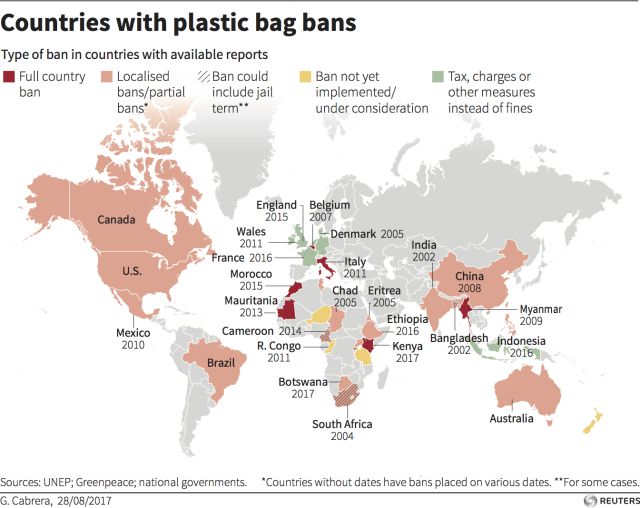
This measure is adopted because of the effect of the plastic bags to the environment. Plastic bags are often used for a few minutes before enjoying an eternal afterlife, clogging storm drains, stuffing landfills, killing animals that eat them and contributing to the eight million metric tons of plastic that end up in the world’s oceans every year. More than 40 countries, including China, France and Rwanda, have taxed, limited or banned plastic bags. And not to forget a number are also considering the ban

Below is a diagram with details on the countries.

countries that have ban plastic bags

The United Nations, which estimates that, by weight, there will be more plastic than fish in the world’s oceans by 2050 if the world doesn’t act, has begun a #CleanSeas campaign to eliminate the use of plastic microbeads and single-use plastic bags by 2022.

However, countries like Sweden and Norway, are doing remarkably well in waste management and yet they have not adopted this measure (plastic ban). In fact, they are using waste as a source energy. It is becoming one of Norway’s fuel of choice. The waste is turned into heat and electricity for the city of Oslo. According to Mr. Pal Mikkelsen, the director of waste-to-energy in Oslo, “Four tons of waste has the same energy content as one tons of fuel oil.” He also stated, “One ton of fuel oil, could heat a house for half a year.” These waste products include plastic bags which can no longer be recycled any more. The rubbish is pre-sorted. Everything that can be recycled is meant to have been taken out before the process starts. These two countries have zero waste. You would have thought running out of rubbish would be a blessing rather than a curse. Yet in Norway, the lack of waste is becoming a major headache for the waste management business that they resort to importing waste from other countries. Wrap your head around that!

Thinking of my country, where youths got no jobs, yet considering the fact that we still produce inadequate power, why can’t we adopt such a system (waste-energy conversion) and hit three bird with a single stone? I suggest that we should have a balance in terms of percentage of production and the usage of plastic bags and other alternatives to create a sustainable model based on efficiency, durability and environmental friendliness. And this can be enforced and achieved at the production level, by regulating the manufacturing and production of each of these products. Banning of plastic bags alone is not the solution, don’t we still pack several other products ranging from food products like cooking oil and sodas to cosmetic products and industrial products like paints in plastic containers? And yet they are equally harmful is disposed of. Does this demonstrate an element of double standard in our country?

It is important to note that until recently, plastic bags offered the best mode of hygienic packaging solution to the food vendors. Finding a better alternative for them would be a win-win situation for both the vendors and costumers but until then, we are stuck in a limbo.  Remember that the cost of producing alternative bags like paper and cloth bags is also high. Other notable dire consequences of paper as an alternative are; high consumption of energy during its production process thus leaving behind a larger carbon footprint than plastic, deforestation incase of unsustainable production methods, and consumption of lots of clean water during production thus the risk of depletion of clean water reserve. As innocent as they might look, these alternatives would prove to be more harmful than even the plastic bags if no controlled too.

We should however be realistic, the effects of plastic bags in our environment is due to our negligence. We are careless, and we dispose things not mindful of the harm we are causing. This is due to NO or poor measures put in place by our government or relevant institution for such matters. Member of our society also have limited education on waste management and environment conservation as well.

The following are measures that should be put in place, not only in Kenya but by the entire International system. The use of plastic bags should be regulated by ensuring that only a manageable percentage is released to the market, the quality of the bags should be high and the components for producing such bags should be environmentally friendly. These plastic bags upon use should be recycled instead of being disposed, and for those that cannot be recycled, should be converted to other use like making energy just like it’s the case with Norway and Sweden.

The government and other relevant institutions like the municipal or the county government and NEMA, should play a key role in ensuring that there is proper waste management mechanism in place. This is by ensuring there is proper collection and sustainable disposal of waste. They should also carry out activities which contribute to creating awareness of waste management. They should advocate for alternatives for paper bags which are environment friendly and cheaply produced. Measures such as wet and dry scrubbing during cremation should be enforced to avoid pollution of the air in case of waste-energy conversion is carried out.

There should be an evaluation on the amount of paper to produce, ensuring a sustainable production to avoid deforestation and excessive energy consumption. For instance, considering formulation of an integrated production technique in terms of percentages of these products depending on their potential impact to the environment (e.g. 1% will be plastic bags, 2% will be paper bags, 90% will be water hyacinth, fiber, sisal, reeds) Water hyacinth would be the highest because of its potential of helping the reduction of it in our lake.

Our education system should also include environment conservation and waste management as a key subject. This will bring up a generation that is knowledgeable on the importance of protecting their environment. Hence it will lead to a culture or a society of environmental responsibility and awareness.

Plastic bags have become one of the greatest pollutants in the current era. Just as Jeb Barrier said, ‘think about it. Why would you make something that you’re going to use for a few minutes out of a material that’s basically going to last forever, and you’re just going to throw it away? What’s up with that?” Banning of plastic alone won’t save us, we have to evaluate and use all the available option at our disposal. Above all, creating a culture of recycling and conservation like in Norway and Sweden seems to be the most effective method. This is our planet lets save it now, responsibility starts with me and you.

traditional african bagSHOSH BASKETBELINE BASKET

The Glamour of Cultural Diversity


The trees, tall and mighty, scaling up high into the sky, creating a magnificent canopy of natural umbrella. Both the Blue and Red tail Monkeys seem to get along just fine here. The rainbow show created by a variety of colorful butterflies is way too conspicuous to ignore. But you have to leave before the heavy afternoon rain pours. You hesitate, but the thought of that yummy hot brown ‘obusuma’ (ugali) served with chicken stew, makes you happily leave Kakamega forest. The locals are very generous and full of energy, you feel very much alive too… The gentle cold breeze massages your face romantically, its soothing effect makes you feel connected to this place. Just a few kilometers away, the view of the majestic City of the Sun, Kisumu City, rising proudly by the shores of Lake Victoria, looking all calm and peaceful, is fascinating. You were lucky to spot a few hippos at Impala sanctuary, and now you have to join the tall, eloquent and heartfelt locals for a mouthwatering dish of ‘ngege’ (tilapia) served with ugali…The Sun is gracefully scorching the land with enthuse, you pay no attention, because the beautiful landscape of plain grassland bounded with gorgeous hills of almost perfectly formed curves, wouldn’t let you. The heavy presence of the Maasai warriors dressed in traditional attires, makes those ‘Man-Eater Lions stories’ a child’s play, you are at peace. Soon the sweet aroma of ‘nyama choma’ is going to arouse your appetite as it diffuses through Maasai Mara… Green is the color here, the land is wet and full of life; you literally forget your worries. You can now witness the divine, snow-peaked mountain towering up into the clouds, it’s more beautiful than it appears in the pictures. The natives call it ‘Kirima’- mountain with white features. It’s the perfect opportunity to enjoy food of the soil, ‘waru’ and ‘minji’ are in plenty, and it goes well with the company of the hospitable, warm and welcoming locals… Hot and humid is the order of the day, you are barely comfy under your own skin. Surprisingly, the locals are not moved, in fact most of them are all dressed up in ‘buibui’. Their ascent and eloquent command of Swahili language is jaw dropping that you almost forget the presence of the alluring Indian Ocean right in front of you, marked with ravishing white sand beaches- dotted with symmetrical and slender coconut trees. The locals are known for their splendid cooking skills; the Swahili cuisine comprising of ‘pilau, biryani, samosa, kaimati, mahamri and bhajia,’ is irresistibly delicious…
Embracing cultural diversity in the society is an important step in a country. It brings about the benefits of each cultural practices. Countries like Canada and Australia which are embracing cultural diversity, are excellent examples to demonstrate its advantages. They appreciate and respect each culture. In fact they embrace different cultures. Through this practice, both the two countries are known to be doing extremely good both economically, socially and even politically. Germany has also joined in the practice by giving permanent residency to foreigners and also adopting certain policies that embrace cultural diversity. Yet in the past, German was known for racism. In Africa, Ghana is known to appreciate diversity just by voting someone from minority tribe as the president. This act, demonstrate, that Ghanaians select their leaders based on credibility but not ethnic alienation like it’s the norm in most African countries.

They say partition of African states by Berlin conference of 1684-1685 was a mistake. It led to instability in Africa (ethnic rivalry).This is something that I disagree with. In fact, it is an excuse for our failure. Have you ever thought how Africa was before the partition? Despite the occasional disputes amongst the different communities, which on the extreme lead to tribal wars, these communities really depended on each other for both social and economic development. Their cultural diversity meant that one community could offer what the other couldn’t, and this led to development of trade amongst them. Even during precolonial period, intermarriages across different communities was practiced. This was an element of embracing cultural diversity.

In Kenya, Kikuyu’s are known to be aggressive when it comes to business, Luo’s on the other side are known to be good in regard to education and intellectual capabilities, Kalenjin’s are known to be good in regards to sports (marathon), coastal region for its hospitality among others. If all this attributes are brought together, the country will be doing well economically. Diversity of thought has been shown to breed creativity and drive innovation, helping to solve problems.  Multiple voices, perspectives, and personalities bouncing off one another can give rise to ‘out-of-the-box’ kind of thinking.

What do you think life will be if each country would only have one group?

Personally, I am privileged to have lived amongst different communities in my country. Mostly among the Agikuyu and Luo community. And with this experience, I appreciate both the two. In fact, it molded me, to be the person I am today. I remember vividly my life in Mguguga, my mother was a teacher at Goriondito Primary school. I was in class two in the same institution. I remember singing to the songs “Kanyoni kaja meremaine…” and “Moshere nemwega oriegwa na geshiko…” among others. To how I used to go farming with my mum. How I used to read the Bible eloquently in Kikuyu… and not to forget the mother tongue language class in Kikuyu. 

I also have treasured memories of my mother land Rusinga. If you happen to know me personally, you can tell the love I have for this place. I used to go hunting known as “temo”. And how I used to occasionally accompany my grandfather fishing on his boat. To how I enjoyed going to fetch fire wood “moto” on the hills. And not forgetting going to swim by the lake sides. In those days, at my grandmother’s, work was communal, this practice was referred as “gosaga” where the entire youths in the community would come and help you farming for free, and you were only expected to cook for them.

People should live cordially and accept each other regardless of their culture, nationality, historical background, religion, ethnicity or other discrimination basis. We should have a heart and mind that acknowledges, accepts, values and celebrates different ways in which people live and interact in our society. People should embrace different and new cultures that impact on their lives positively in order to improve their society and mostly aspire to live and cultivate what is good in their culture in order to have a positive impact on the world. Through this process, we will be ambassadors of our indigenous culture. Just like Tyler Cowen said, “real cultural diversity result from the interchange of ideas, products, and influences, not from the insular development of a single style.”

For more information you can read (https://belinenyangionglobalrelations.wordpress.com/2016/10/20/ethnocentrism-as-the-toxin-to-african-development/?preview=true