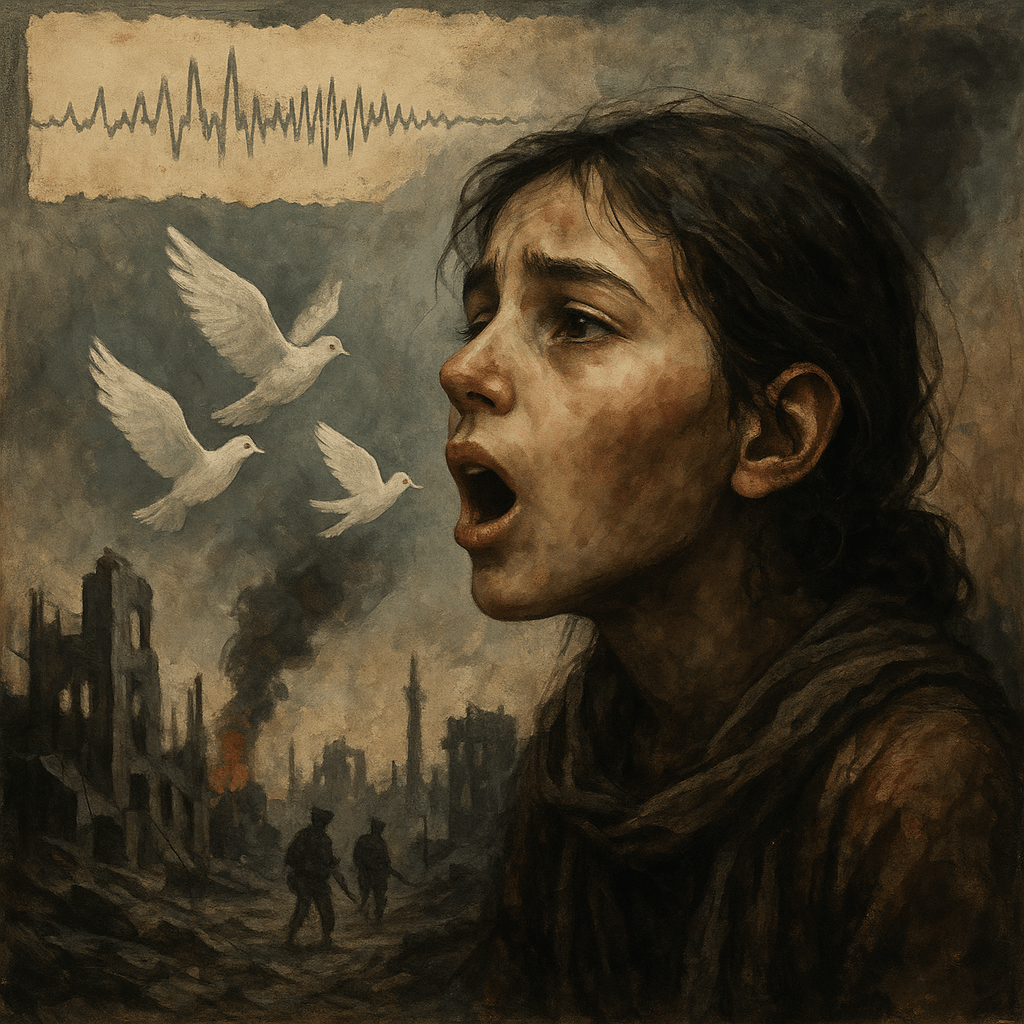
Picture credit:AI generated
At dawn in Sudan’s Darfur region, Mariam tightens a threadbare scarf around her shoulders. Around her, smoke curls from burned homes, and gunfire echoes over the dusty plains. The war that erupted between the Sudanese Armed Forces and the Rapid Support Forces has now plunged the nation into one of the world’s most catastrophic humanitarian crises. In some regions, famine has begun, quietly claiming lives, especially of children. Aid groups are pleading for safe corridors, but violence and looting make deliveries almost impossible (United Nations, 2024).
Meanwhile in Gaza, 14-year-old Omar scrawls poetry in a tattered notebook, the walls of his school, what’s left of it, scarred with shrapnel. More than 50,000 Palestinians have been killed in the Israeli military operation launched after the October 2023 Hamas attacks, with women and children making up a devastating portion of the casualties (UN OCHA, 2025). Starvation is now a weapon of war, hospitals are nonfunctional, and children like Omar are growing up too fast, too soon, under the shadow of drones.
Thousands of miles away in the mineral-rich hills of eastern Congo, Amina, a schoolteacher turned refugee, now teaches children by drawing in the dust. The M23 rebel group, backed by Rwandan military support, has overrun towns in North Kivu. Violence and displacement have uprooted nearly 700,000 people this year alone (Human Rights Watch, 2025). Children go missing during attacks. Schools, clinics, and even UN shelters have come under fire.
In Myanmar, Ko, a rice farmer, watches his fields rot under the monsoon rain. The junta’s brutal campaign against opposition forces has bombed entire villages. Schools are militarized, hospitals raided, and millions displaced, with little hope of return (International Crisis Group, 2025).
In Iran and Israel, the tension crackles like electricity in the air. After a series of drone and missile strikes between the two nations, dozens have died, oil depots have exploded, and civilians huddled in bunkers. Each act of retaliation fuels the next. Though world leaders have called for calm, both nations remain defiant (The Guardian, 2025; Associated Press, 2025).
The Human Cost
What unites Mariam, Omar, Amina, Ko and millions more isn’t just suffering. It’s invisibility. Each lives in a war that the world occasionally notices before moving on. But these are not isolated tragedies. Conflicts today are more interconnected than ever. Food shortages in Sudan affect global grain prices. Bombings in Gaza inflame tensions across the Middle East. The Congo’s instability slows electric vehicle supply chains globally.
But what’s Being Done?
Some governments and international organizations are responding. The UN has attempted to broker ceasefires in Sudan and pushed for humanitarian access in Gaza. Humanitarian agencies are delivering what aid they can, often at great personal risk. Peacekeeping operations in Congo and diplomatic pressure on Myanmar have slowed some violence, but not nearly enough (UNHCR, 2025; Amnesty International, 2025).
France, Germany, and the UK have condemned the Iran–Israel escalation, urging de-escalation through backchannel diplomacy (Reuters, 2025). Meanwhile, the UN Security Council has extended sanctions on arms sales to South Sudan, hoping to prevent yet another civil war (United Nations, 2025).
Civilians and activists around the world are also protesting against the conflict. The latest being activist chanting at Schiphol airport, Amsterdam “One we are the People; two we won’t be silenced; three let’s stop the bombing now!now! now!” before heading to Egypt to join thousands planning to march on foot to the besieged enclave (Aljazeera news,2025)
But there is a growing call for more preventive diplomacy, not just reacting after violence erupts, but investing in peace before it does. This includes funding education, supporting youth leaders, protecting environmental resources that often trigger local conflicts, and including women in peace talks, not just as victims, but as negotiators (UN Women, 2025).
What Can We Do?
The truth is, we’re not powerless. Citizens can pressure their governments to fund peacebuilding, not just weapons. Donors can prioritize women-led initiatives in war-torn communities [I remember back in my undergraduate class, learning on the importance of women in peacebuilding but surprisingly this is something that is not much practised]. Schools and universities can educate on the causes of conflict and build empathy across cultures. And we, as individuals, can amplify the stories of people like Mariam, Omar, and Ko so they are not forgotten.
Because every time we allow a war to become a statistic, we let a life slip quietly from view.
References
Amnesty International. (2025). Myanmar: Civilians caught in crossfire as junta escalates attacks. https://www.amnesty.org
Associated Press. (2025, June 15). Death toll grows as Israel and Iran trade attacks for third day. https://apnews.com/article/291df01b03179cd414db21ca33791b39
Human Rights Watch. (2025). DR Congo: Civilians at risk as rebels advance in eastern provinces. https://www.hrw.org
International Crisis Group. (2025). Myanmar’s slow descent into state failure. https://www.crisisgroup.org
Reuters. (2025). UK, France urge calm as Iran-Israel conflict escalates. https://www.reuters.com
The Guardian. (2025, June 15). Iran and Israel threaten escalation as global powers call for restraint. https://www.theguardian.com
UNHCR. (2025). Global displacement hits a new record as conflicts surge. https://www.unhcr.org
UN OCHA. (2025). Occupied Palestinian Territory: Humanitarian needs overview. https://www.unocha.org
UN Women. (2025). Women’s role in peacebuilding: From words to action. https://www.unwomen.org
United Nations. (2024). Sudan: One year of war and humanitarian collapse. https://www.un.org
United Nations. (2025). Security Council extends arms embargo on South Sudan. https://www.un.org

 belinenyangi'sdiscussion#oursociety#