From Tweets to Streets: A Kenyan Reckoning Told From Afar

“It’s Ojwang,” my mum said. “I have to stay online.”

I didn’t think a phone call could carry so much weight. My mum was calling from Mbita-Kenya, pacing in the house, while I was thousands of miles away—across borders, time zones, and seasons. She had barely slept. “I need to follow this Ojwang story,” she said, pausing every few seconds to refresh her Twitter—now X—feed.

A few hours later, my boyfriend called from another country. He had been following the Kenyan news all day, as he often does. When I visited him some months ago, I noticed how he immersed himself in it—streaming local channels, flipping between NTV, Citizen, and even lesser-known YouTube political panels. It was his way of staying connected. On this call, his voice carried more than just concern. “I just need to say it out loud,” he told me. “Imtoke.” That Swahili word didn’t just express anger; it carried the weight of frustration and fatigue.

Then came my mum’s second call, this time more anxious. “Your brother hasn’t come back. He left yesterday morning and isn’t picking up his phone.” She tried to sound calm, but I could hear the worry beneath her words. “There have been kidnappings and missing persons cases,” she whispered. “I’m really worried.”

The death that changed the conversation

Albert Ojwang was not a public figure in the traditional sense. He was a teacher and a writer, known for his honesty and boldness. Earlier this year, he had shared a post critical of Deputy Inspector-General Eliud Lagat, raising concerns about corruption. Not long after, he was found dead in a Nairobi police cell.

The official explanation pointed to a fall, but the postmortem suggested otherwise: bruises, head trauma, and neck injuries. CCTV footage from the police station had reportedly been altered. What began as a social media post had ended in tragedy, and with it came a wave of grief and questions.

A movement beyond one man

The protests that followed Ojwang’s death reflected more than the loss of one life. Crowds gathered in Nairobi, Mombasa, Kisumu, Nakuru, and other towns, demanding answers. The chants—“Justice for Ojwang!” and “Stop Killing Us!”—spoke to a broader frustration with patterns of injustice.

From where I was, I watched the news late into the night. My boyfriend did the same, and we exchanged calls between updates. We tried to make sense of it, to process the scenes unfolding on our screens.

During one of the demonstrations, a young hawker named Boniface Kariuki was fatally shot. The government responded by arresting two police officers, and Deputy Inspector-General Lagat stepped aside as investigations began. Yet for many, these actions felt like only the beginning of a much longer conversation about accountability.

Echoes of 2024

It wasn’t the first time the streets filled with voices demanding change. Just a year earlier, in 2024, young people—especially Gen Z—had led nationwide protests against a Finance Bill that many felt placed an unfair burden on ordinary citizens. The demonstrations were as much about economic policy as they were about trust, transparency, and inclusion.

What made that moment remarkable was how seamlessly digital organizing turned into real-world action. Messages shared on social media became marches. Live streams became evidence. The protests made an impact—the bill was eventually withdrawn.

Where we are today

Ojwang’s death has brought that spirit back to the surface, but with deeper questions about what has changed and what remains. The Finance Bill for 2025 has passed, albeit with some amendments following public feedback. Certain clauses, including ones linked to data privacy concerns, were dropped. Yet, for many, the sense of vulnerability persists—whether in the streets, online, or at home.

My mum now hesitates to let my brother stay out late. “They’re picking up young men,” she told me quietly. “Sometimes, for nothing more than being in the wrong place at the wrong time.” Each time I call and he answers, it feels like a small relief.

Signs of resilience

Despite the uncertainty, what stands out is how young people continue to find ways to engage. From peaceful demonstrations to legal challenges, from creative digital advocacy to community organizing, they are reshaping how citizens participate in national dialogue. The calls for accountability, fairness, and reform remain steady.

What is clear is that this is no longer just about individual incidents. It’s about a collective journey, a nation grappling with difficult questions, and a generation finding its voice.

A shared story

Though I am far from home, I feel part of this story with every call I make, every update I follow, and every conversation I have with loved ones. My mum is living it. My boyfriend follows it closely. My brother navigates it daily.

Distance can feel isolating at times. But it has also shown me that the desire for justice, dignity, and peace crosses borders. It lives in the voices that refuse to go quiet, in the families who worry and hope, and in the countless small acts of courage that are shaping Kenya’s future.
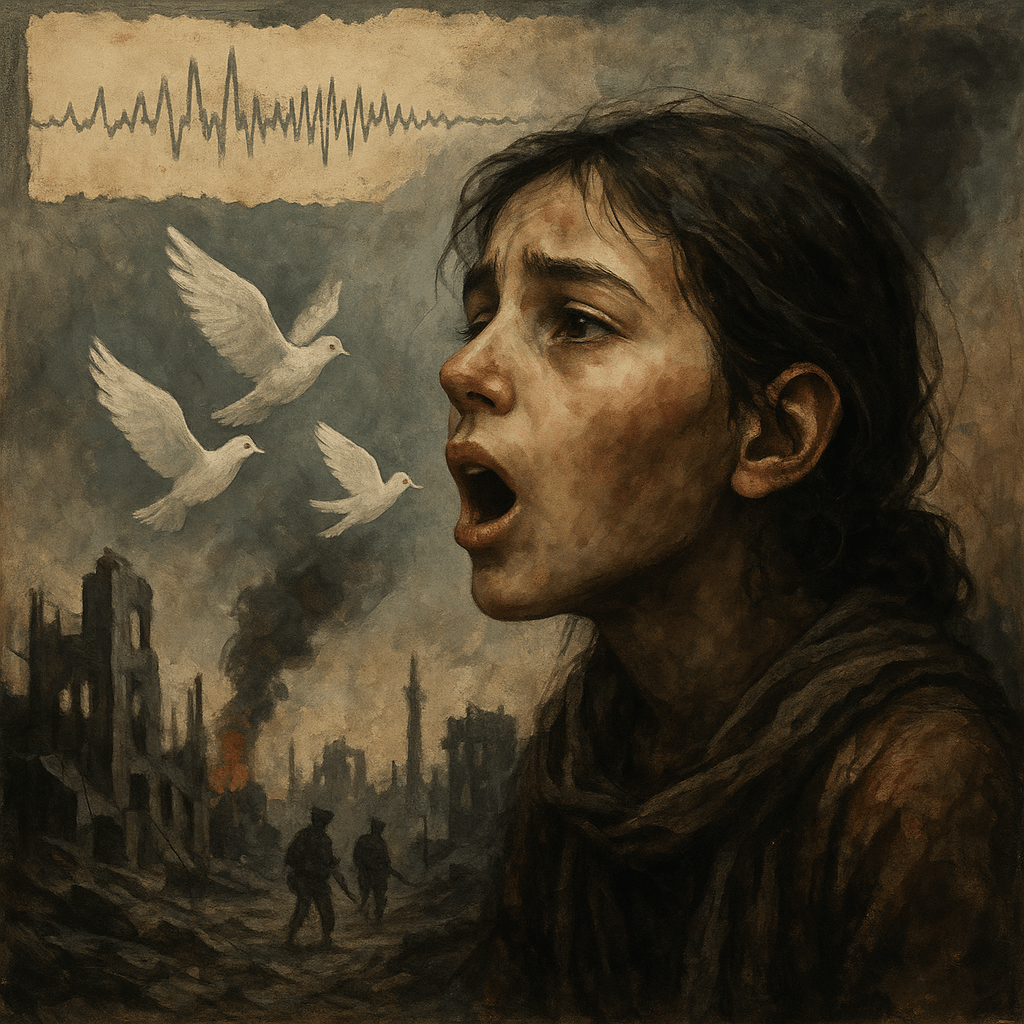
Whispers from Warzones: Voices the World Must Hear

Picture credit:AI generated

At dawn in Sudan’s Darfur region, Mariam tightens a threadbare scarf around her shoulders. Around her, smoke curls from burned homes, and gunfire echoes over the dusty plains. The war that erupted between the Sudanese Armed Forces and the Rapid Support Forces has now plunged the nation into one of the world’s most catastrophic humanitarian crises. In some regions, famine has begun, quietly claiming lives, especially of children. Aid groups are pleading for safe corridors, but violence and looting make deliveries almost impossible (United Nations, 2024).

Meanwhile in Gaza, 14-year-old Omar scrawls poetry in a tattered notebook, the walls of his school, what’s left of it, scarred with shrapnel. More than 50,000 Palestinians have been killed in the Israeli military operation launched after the October 2023 Hamas attacks, with women and children making up a devastating portion of the casualties (UN OCHA, 2025). Starvation is now a weapon of war, hospitals are nonfunctional, and children like Omar are growing up too fast, too soon, under the shadow of drones.

Thousands of miles away  in the mineral-rich hills of eastern Congo, Amina, a schoolteacher turned refugee, now teaches children by drawing in the dust. The M23 rebel group, backed by Rwandan military support, has overrun towns in North Kivu. Violence and displacement have uprooted nearly 700,000 people this year alone (Human Rights Watch, 2025). Children go missing during attacks. Schools, clinics, and even UN shelters have come under fire.

In Myanmar, Ko, a rice farmer, watches his fields rot under the monsoon rain. The junta’s brutal campaign against opposition forces has bombed entire villages. Schools are militarized, hospitals raided, and millions displaced, with little hope of return (International Crisis Group, 2025).

In Iran and Israel, the tension crackles like electricity in the air. After a series of drone and missile strikes between the two nations, dozens have died, oil depots have exploded, and civilians huddled in bunkers. Each act of retaliation fuels the next. Though world leaders have called for calm, both nations remain defiant (The Guardian, 2025; Associated Press, 2025).

The Human Cost

What unites Mariam, Omar, Amina, Ko and millions more isn’t just suffering. It’s invisibility. Each lives in a war that the world occasionally notices before moving on. But these are not isolated tragedies. Conflicts today are more interconnected than ever. Food shortages in Sudan affect global grain prices. Bombings in Gaza inflame tensions across the Middle East. The Congo’s instability slows electric vehicle supply chains globally.

But what’s Being Done?

Some governments and international organizations are responding. The UN has attempted to broker ceasefires in Sudan and pushed for humanitarian access in Gaza. Humanitarian agencies are delivering what aid they can, often at great personal risk. Peacekeeping operations in Congo and diplomatic pressure on Myanmar have slowed some violence, but not nearly enough (UNHCR, 2025; Amnesty International, 2025).

France, Germany, and the UK have condemned the Iran–Israel escalation, urging de-escalation through backchannel diplomacy (Reuters, 2025). Meanwhile, the UN Security Council has extended sanctions on arms sales to South Sudan, hoping to prevent yet another civil war (United Nations, 2025).

Civilians and activists around the world are also protesting against the conflict. The latest being activist chanting at Schiphol airport, Amsterdam “One we are the People; two we won’t be silenced; three let’s stop the bombing now!now! now!” before  heading to Egypt to join thousands planning to march on foot to the besieged enclave (Aljazeera news,2025)

But there is a growing call for more preventive diplomacy, not just reacting after violence erupts, but investing in peace before it does. This includes funding education, supporting youth leaders, protecting environmental resources that often trigger local conflicts, and including women in peace talks, not just as victims, but as negotiators (UN Women, 2025).

What Can We Do?

The truth is, we’re not powerless. Citizens can pressure their governments to fund peacebuilding, not just weapons. Donors can prioritize women-led initiatives in war-torn communities [I remember back in my undergraduate class, learning on the importance of women in peacebuilding but surprisingly this is something that is not much practised]. Schools and universities can educate on the causes of conflict and build empathy across cultures. And we, as individuals, can amplify the stories of people like Mariam, Omar, and Ko so they are not forgotten.

Because every time we allow a war to become a statistic, we let a life slip quietly from view. 

References

Amnesty International. (2025). Myanmar: Civilians caught in crossfire as junta escalates attacks. https://www.amnesty.org

Associated Press. (2025, June 15). Death toll grows as Israel and Iran trade attacks for third day. https://apnews.com/article/291df01b03179cd414db21ca33791b39

Human Rights Watch. (2025). DR Congo: Civilians at risk as rebels advance in eastern provinces. https://www.hrw.org

International Crisis Group. (2025). Myanmar’s slow descent into state failure. https://www.crisisgroup.org

Reuters. (2025). UK, France urge calm as Iran-Israel conflict escalates. https://www.reuters.com

The Guardian. (2025, June 15). Iran and Israel threaten escalation as global powers call for restraint. https://www.theguardian.com

UNHCR. (2025). Global displacement hits a new record as conflicts surge. https://www.unhcr.org

UN OCHA. (2025). Occupied Palestinian Territory: Humanitarian needs overview. https://www.unocha.org

UN Women. (2025). Women’s role in peacebuilding: From words to action. https://www.unwomen.org

United Nations. (2024). Sudan: One year of war and humanitarian collapse. https://www.un.org

United Nations. (2025). Security Council extends arms embargo on South Sudan. https://www.un.org