
In my previous post I mentioned that divide of Africa might not be the cause of Africa misfortune. This has kept me thinking what the causes are/ were. “Can Slave trade be one of the major causes of this misfortune?” I wonder.
In 2015, I was privileged to work with an organization known as HAART Kenya, whose main purpose is working to end human trafficking in Kenya. They refer to it as Modern Slave trade (story for another day). Over the period there, I was exposed to what slavery is and what impact it has in our society.
The Trans-Atlantic slave trade radically impaired Africa’s potential to develop economically and maintain its social and political stability. Why do I say so? This exchange triggered a continuous process of exploitation of Africa’s human resources, labor, and commodities. This exploitative commerce influenced the African political and religious aristocracies, the warrior classes and the biracial elite, who made small gains from the slave trade, to participate in the oppression of their own people.
Way back in the 15th to 19th Century, All of us were not born. Our history records, Young energetic men, children and beautiful women being taken away by force to Europe. In exchange of few goodies for the selfish. Just the act of self-interest and greed by few individuals, led to the impaired-ness we are currently facing.
At least 12 million African men, women and children were forcefully transported in bondage to the Americas, within a three and a half century period. This was the trans-Atlantic slave trade which represented one of the longest and most sustained assaults on the very life, integrity, and dignity of human beings in history. This is due to the fact that the slave trade was brutal and horrific, and the enslavement of Africans was cruel, exploitative, and dehumanizing. The trans-Atlantic slave trade laid the foundation for modern capitalism, generating immense wealth for business enterprises in America and Europe. While the trade was contributing to the industrialization of northwestern Europe and creation of a single Atlantic world that included western Europe, western Africa, the Caribbean islands, and the mainland’s of North and South America, it left Africa bleeding and broken.
The mid seventeenth century marked the climax of the slave trade, which was at its most intense phase. This was as a result of the creation of ever-larger sugar plantations and the introduction of other crops such as indigo, rice, tobacco, coffee, cocoa, and cotton in the Americas. This large plantations needed a lot of labor which could not be sustained by the few slaves and the natives, therefore, salves in large numbers were acquired and taken to Americas. Some slave traders – often well-respected men in their communities – made fortunes for themselves and their descendants. The corresponding impact on Africa was intensified as larger parts of west and central Africa came into the slavers’ orbit.
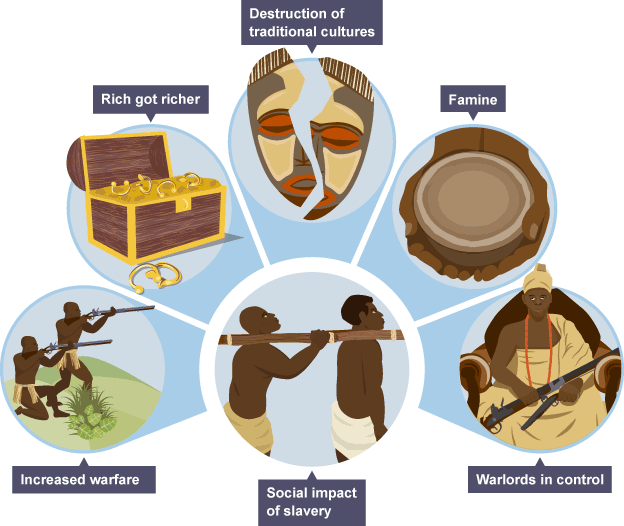
Trans-Atlantic slave trade caused a heartbreaking and detrimental effect to the Africans—the mere fact that Africans were raiding their fellow Africans, to capture them as slaves, and forcefully hand them over to European slave colonies in form of trade—This sad vice lead to ethnic fragmentation of Africans. Hostility among neighboring villages, communities and states escalated since they raided each other, capturing men, women and children to trade as slaves in exchange for arms and other commodities. The previously established codes of conduct (concerning warfare)–meant to create peace– were abolished, heightening levels of insecurity. Social interaction was highly compromised following high levels of insecurity among various social groups, and this led to confinement of populations within their respective ethnic boundaries and groups. Due to the rising incidences of conflicts, suspicion and banditry, arising from trans-Atlantic slave trade, there was destruction of almost all the village networks and federations, that had been created before, in the 19th century (Curtin 198).
We are all very familiar with the consequences of insecurity, it causes fear, an emotion which must be acted upon. The high demand for slaves by the European colonies exerted lots of pressure on the African communities, thus leading to conflicts and even catastrophic war among these communities. As a result, African States were weakened and fragmented. These African communities had to protect themselves from attacks by other communities, thus resorted to arming themselves with weapons available that time like knives, swords, firearms and spears. The only complication was that these weapons could only be acquired from the European colonies, and through the exchange of slaves! Yeah! You get the picture. The only way to arm and protect yourselves from attacks from neighboring communities was to attack your neighboring communities to capture slaves, and trade them for weapons! Everything seemed wrong with this, defending evil with evil leading to more evil! This escalated slave trade and created much more hatred between African states, due to the act of enslaving one another for security and protection. One good example in the 19th century was the Kabre community of Togo; which engaged in delivering of their own kin to European colonies in exchange of iron knives, and spears for defense (Curtin 184).
What followed was political instability, it’s pretty simple, what would the weakening and fragmentation of African States result into? If you think this time fell short of conspiracies and evil plots which would only be possible in the modern times, you are wrong. Europeans with their Africa partners intentionally caused political instabilities in most African states for their own benefits. They participated in intervention of various political processes so as to create internal instabilities and conflicts as this translated into more slaves for them. The raiders and merchants of slavery formed alliances with various groups in villages and States purposely to get slaves. Since most of the community young men were frustrated by the fact that power was under control of elderly men, they readily made alliances with these merchants to extract slaves. This actually led to increased political instability, internal conflicts and ultimate weakening of the States. Most of the pre-existing forms of government collapsed due to internal conflicts and increased political instability. For instance, the weakening of political institutions domestically occurred within the West Central Africa’s Kongo Kingdom, where the local Kongo citizens were kidnapped in early 1514, and handed over or sold to Portuguese slave merchants. This scenario became rampant with time and created lots of social and political disorder, leading to collapse of the entire Kingdom and the King’s authority (Curtin 198).
Criminals were good news to the slave merchants since they automatically qualified as easy take as slaves without a break of sweat. For this reason therefore, they resorted to using false accusations against individuals for community crimes like the dreaded witchcraft to criminalize many individuals. Majority of African communities had a well-established judicial and punishment penalties for such crimes at this time. However, these merchants took advantage of this system to convert the penalties into enslavement. Examples of some converted penalties included but not limed to: ex-communication from the community, beatings, compensation, and exile (Nunn 153). As a result, those who were falsely accused automatically become enslavement candidates. This practices subsequently resulted into deterioration of the established legal institutions due to abuse of the judicial system, with leaders supporting this tribute to protect their communities and themselves. A good example was the Cassanga chief, who engaged in punishing the community members by giving them poison. Those who took the poison and vomited were pronounced guilty and immediately sold to slavery merchants. For those that failed to vomit, they actually faced death due to poisoning. Their family members, who had remained behind, were then manipulated, seized of any available property and handed over to slavery merchants for shipping. It is these kinds of acts that led to total deterioration of the legal systems, which had been put in place prior to occurrence of the trans-Atlantic slave trade (Nunn 167).
What would you do if you are living in a place close to where dangerous criminal dealings occur? The most logical act is to move away as far as possible due to the fear of being a victim of their criminal activities. This is exactly what most African communities opted for, fleeing. The slave merchants had various distinct routes which they used to transport the slaves they had raided and capture to the coast, where they were gathered, branded and shipped. Majority of communities, which were living along these particular routes, were forced to migrated and flee for the sake of their safety since they were vulnerable to attacks. This unwanted displacement of these communities subsequently resulted into abandonment of various activities, projects and investment opportunities. People had to abandon their lands and farming activities, this impacted agriculture to a great margin as an economic activity. This led to DE-stabilization of many economies of the Africa States during the entire period of the slave trade (Engerman 64).
Trans-Atlantic slave trade was the black plague to Africans. What good could possibly come out of a practice which involved humans treated worse than animals? Many Africans met their deaths due to this slave trade in the course of its entire period. Impacts of slave trade like conflicts, inter-ethic fragmentation, political unrest, and other forms of disorder, led to many killings, which saw many innocent Africans, lose their lives. A part from those who were killed during raids and wars in pursuit for slaves, many more Africans, who were captured and transported to the coast for shipping also died on the way due to ruthless handling, merciless beating, and excessive use of force. The colonies inside Africa also started fighting against each other over slaves, thus leading to massive killings. It is these massive killings that led to stagnation of the population of Africa, nearly for the entire period of 19th century (Engerman 87).
Frequent raids, conflicts and displacements caused be trans-Atlantic led to loss of lots of property. In some cases an entire village was torched to the ground by raiders and people held captive leading to loss of millions worth of properties. In fact, those who were raided and captured had their property destroyed, or taken away, by other powerful members of the society, without seeking permission or clarification from the immediate family members (Whatley 82).
Summing up all the above effects of trans-Atlantic slave trade, they all contributed to a grand effect. Economic development in most of the African States stagnated due to these effects of slave trade, this was majorly due the fact that quit a number of African human resource was lost slave trade. Human resource is the most importance resource when it comes to production and development of economy. Some states thrived in wealth amassed from slave trade which become a lucrative economic activities which also led to dependence on European goods, since other economic activities become unpopular or even abandoned. When slave trade was finally banned by Britain and United States, the African states which thrived on slaves collapsed and become vulnerable to conquest and colonization. The Europeans firearms fueled war and instability which continued to this day.
Trans-Atlantic slave trade was a contributor to the racism ideology. Most African slavery had no deeper reasons than legal punishment or tribal warfare. But the Europeans who preached a universal religion of Christianity, who were against enslavement of fellow Christians, needed a justification for a practice which was obviously against their beliefs and ideology of equality. So in order to justify the enslavement of the Africans, they claimed that Africans were biologically inferior and were destined to be slaves. For this reason therefore slavery in Americas attained a racial basis, thus making it impossible for the slaves and their future descendants to gain equal status in the society.
In conclusion, it is obvious that Trans-Atlantic trade is likely to be one of the major causes of African misfortune that I have indicated above. The question now is, what should we do to rectify this damage which trickles down to date?

 belinenyangi'sdiscussion#oursociety#