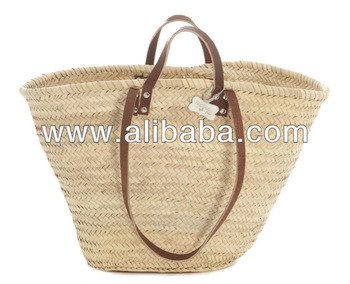

…She is seated under a Croton tree with a traditional stool “orindi”. With her is “othith” sisal and dried water hyacinth that she had collected from Lake Victoria few weeks ago. The sisal and hyacinths are colored in variety of shades. She is half way making a “kiondo” or “okapu” (basket). I am seated next to her on “par” (carpet or mat made from reeds), trying to emulate what she is doing. Beside us, there are three beautiful baskets that my grandmother had already completed. I must admit, I love them. But this is not the case for a lot of youths, in fact, “kiondo” is uncool and meant for grandmothers, ‘‘shosho,” they say. Some people also dislike it because of inconvenience, they find it bulky to carry along.
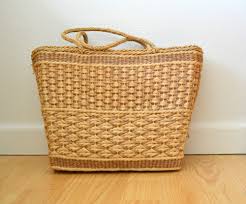
Traditional kiondo, non-woven bags, biodegradable plastic-look-alike bags, woolen paper bags and papyrus baskets, envelopes, and paper bags are the alternatives Kenyan has for the plastic bags. Indeed, Kenya is adjusting to life without plastic bags after a strict ban on the carriers. This is a good move, I must admit. But how good is good? I ask myself.
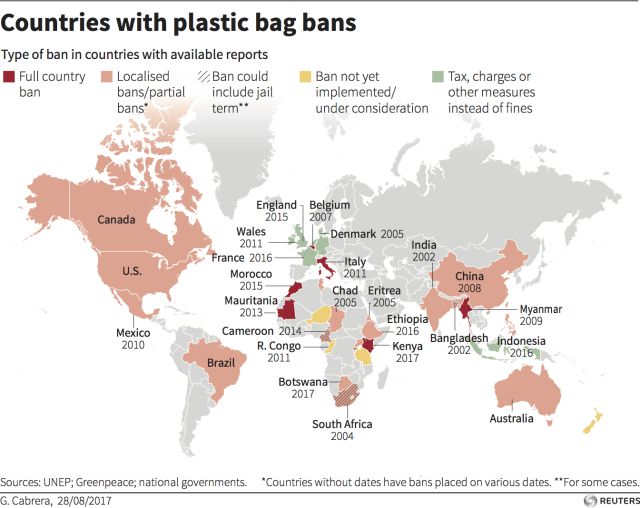
This measure is adopted because of the effect of the plastic bags to the environment. Plastic bags are often used for a few minutes before enjoying an eternal afterlife, clogging storm drains, stuffing landfills, killing animals that eat them and contributing to the eight million metric tons of plastic that end up in the world’s oceans every year. More than 40 countries, including China, France and Rwanda, have taxed, limited or banned plastic bags. And not to forget a number are also considering the ban
Below is a diagram with details on the countries.
The United Nations, which estimates that, by weight, there will be more plastic than fish in the world’s oceans by 2050 if the world doesn’t act, has begun a #CleanSeas campaign to eliminate the use of plastic microbeads and single-use plastic bags by 2022.
However, countries like Sweden and Norway, are doing remarkably well in waste management and yet they have not adopted this measure (plastic ban). In fact, they are using waste as a source energy. It is becoming one of Norway’s fuel of choice. The waste is turned into heat and electricity for the city of Oslo. According to Mr. Pal Mikkelsen, the director of waste-to-energy in Oslo, “Four tons of waste has the same energy content as one tons of fuel oil.” He also stated, “One ton of fuel oil, could heat a house for half a year.” These waste products include plastic bags which can no longer be recycled any more. The rubbish is pre-sorted. Everything that can be recycled is meant to have been taken out before the process starts. These two countries have zero waste. You would have thought running out of rubbish would be a blessing rather than a curse. Yet in Norway, the lack of waste is becoming a major headache for the waste management business that they resort to importing waste from other countries. Wrap your head around that!
Thinking of my country, where youths got no jobs, yet considering the fact that we still produce inadequate power, why can’t we adopt such a system (waste-energy conversion) and hit three bird with a single stone? I suggest that we should have a balance in terms of percentage of production and the usage of plastic bags and other alternatives to create a sustainable model based on efficiency, durability and environmental friendliness. And this can be enforced and achieved at the production level, by regulating the manufacturing and production of each of these products. Banning of plastic bags alone is not the solution, don’t we still pack several other products ranging from food products like cooking oil and sodas to cosmetic products and industrial products like paints in plastic containers? And yet they are equally harmful is disposed of. Does this demonstrate an element of double standard in our country?
It is important to note that until recently, plastic bags offered the best mode of hygienic packaging solution to the food vendors. Finding a better alternative for them would be a win-win situation for both the vendors and costumers but until then, we are stuck in a limbo. Remember that the cost of producing alternative bags like paper and cloth bags is also high. Other notable dire consequences of paper as an alternative are; high consumption of energy during its production process thus leaving behind a larger carbon footprint than plastic, deforestation incase of unsustainable production methods, and consumption of lots of clean water during production thus the risk of depletion of clean water reserve. As innocent as they might look, these alternatives would prove to be more harmful than even the plastic bags if no controlled too.
We should however be realistic, the effects of plastic bags in our environment is due to our negligence. We are careless, and we dispose things not mindful of the harm we are causing. This is due to NO or poor measures put in place by our government or relevant institution for such matters. Member of our society also have limited education on waste management and environment conservation as well.
The following are measures that should be put in place, not only in Kenya but by the entire International system. The use of plastic bags should be regulated by ensuring that only a manageable percentage is released to the market, the quality of the bags should be high and the components for producing such bags should be environmentally friendly. These plastic bags upon use should be recycled instead of being disposed, and for those that cannot be recycled, should be converted to other use like making energy just like it’s the case with Norway and Sweden.
The government and other relevant institutions like the municipal or the county government and NEMA, should play a key role in ensuring that there is proper waste management mechanism in place. This is by ensuring there is proper collection and sustainable disposal of waste. They should also carry out activities which contribute to creating awareness of waste management. They should advocate for alternatives for paper bags which are environment friendly and cheaply produced. Measures such as wet and dry scrubbing during cremation should be enforced to avoid pollution of the air in case of waste-energy conversion is carried out.
There should be an evaluation on the amount of paper to produce, ensuring a sustainable production to avoid deforestation and excessive energy consumption. For instance, considering formulation of an integrated production technique in terms of percentages of these products depending on their potential impact to the environment (e.g. 1% will be plastic bags, 2% will be paper bags, 90% will be water hyacinth, fiber, sisal, reeds) Water hyacinth would be the highest because of its potential of helping the reduction of it in our lake.
Our education system should also include environment conservation and waste management as a key subject. This will bring up a generation that is knowledgeable on the importance of protecting their environment. Hence it will lead to a culture or a society of environmental responsibility and awareness.
Plastic bags have become one of the greatest pollutants in the current era. Just as Jeb Barrier said, ‘think about it. Why would you make something that you’re going to use for a few minutes out of a material that’s basically going to last forever, and you’re just going to throw it away? What’s up with that?” Banning of plastic alone won’t save us, we have to evaluate and use all the available option at our disposal. Above all, creating a culture of recycling and conservation like in Norway and Sweden seems to be the most effective method. This is our planet lets save it now, responsibility starts with me and you.


 belinenyangi'sdiscussion#oursociety#