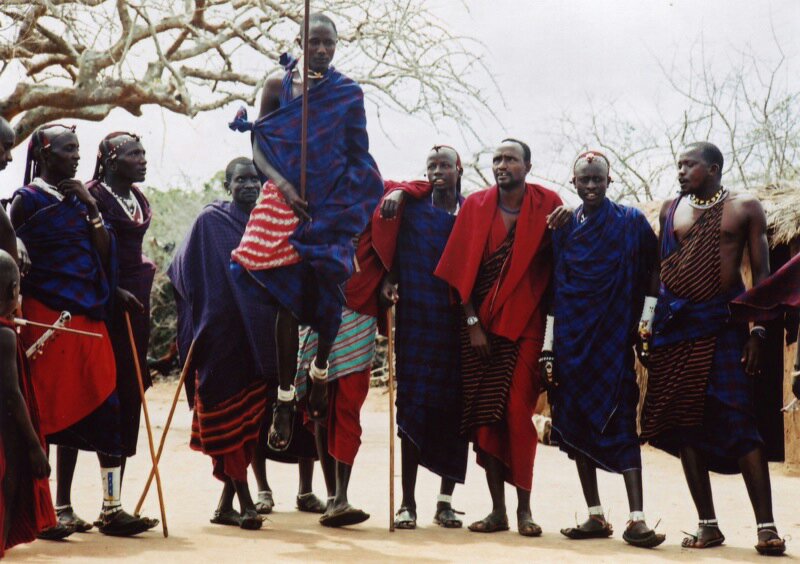
The trees, tall and mighty, scaling up high into the sky, creating a magnificent canopy of natural umbrella. Both the Blue and Red tail Monkeys seem to get along just fine here. The rainbow show created by a variety of colorful butterflies is way too conspicuous to ignore. But you have to leave before the heavy afternoon rain pours. You hesitate, but the thought of that yummy hot brown ‘obusuma’ (ugali) served with chicken stew, makes you happily leave Kakamega forest. The locals are very generous and full of energy, you feel very much alive too… The gentle cold breeze massages your face romantically, its soothing effect makes you feel connected to this place. Just a few kilometers away, the view of the majestic City of the Sun, Kisumu City, rising proudly by the shores of Lake Victoria, looking all calm and peaceful, is fascinating. You were lucky to spot a few hippos at Impala sanctuary, and now you have to join the tall, eloquent and heartfelt locals for a mouthwatering dish of ‘ngege’ (tilapia) served with ugali…The Sun is gracefully scorching the land with enthuse, you pay no attention, because the beautiful landscape of plain grassland bounded with gorgeous hills of almost perfectly formed curves, wouldn’t let you. The heavy presence of the Maasai warriors dressed in traditional attires, makes those ‘Man-Eater Lions stories’ a child’s play, you are at peace. Soon the sweet aroma of ‘nyama choma’ is going to arouse your appetite as it diffuses through Maasai Mara… Green is the color here, the land is wet and full of life; you literally forget your worries. You can now witness the divine, snow-peaked mountain towering up into the clouds, it’s more beautiful than it appears in the pictures. The natives call it ‘Kirima’- mountain with white features. It’s the perfect opportunity to enjoy food of the soil, ‘waru’ and ‘minji’ are in plenty, and it goes well with the company of the hospitable, warm and welcoming locals… Hot and humid is the order of the day, you are barely comfy under your own skin. Surprisingly, the locals are not moved, in fact most of them are all dressed up in ‘buibui’. Their ascent and eloquent command of Swahili language is jaw dropping that you almost forget the presence of the alluring Indian Ocean right in front of you, marked with ravishing white sand beaches- dotted with symmetrical and slender coconut trees. The locals are known for their splendid cooking skills; the Swahili cuisine comprising of ‘pilau, biryani, samosa, kaimati, mahamri and bhajia,’ is irresistibly delicious…
Embracing cultural diversity in the society is an important step in a country. It brings about the benefits of each cultural practices. Countries like Canada and Australia which are embracing cultural diversity, are excellent examples to demonstrate its advantages. They appreciate and respect each culture. In fact they embrace different cultures. Through this practice, both the two countries are known to be doing extremely good both economically, socially and even politically. Germany has also joined in the practice by giving permanent residency to foreigners and also adopting certain policies that embrace cultural diversity. Yet in the past, German was known for racism. In Africa, Ghana is known to appreciate diversity just by voting someone from minority tribe as the president. This act, demonstrate, that Ghanaians select their leaders based on credibility but not ethnic alienation like it’s the norm in most African countries.
They say partition of African states by Berlin conference of 1684-1685 was a mistake. It led to instability in Africa (ethnic rivalry).This is something that I disagree with. In fact, it is an excuse for our failure. Have you ever thought how Africa was before the partition? Despite the occasional disputes amongst the different communities, which on the extreme lead to tribal wars, these communities really depended on each other for both social and economic development. Their cultural diversity meant that one community could offer what the other couldn’t, and this led to development of trade amongst them. Even during precolonial period, intermarriages across different communities was practiced. This was an element of embracing cultural diversity.
In Kenya, Kikuyu’s are known to be aggressive when it comes to business, Luo’s on the other side are known to be good in regard to education and intellectual capabilities, Kalenjin’s are known to be good in regards to sports (marathon), coastal region for its hospitality among others. If all this attributes are brought together, the country will be doing well economically. Diversity of thought has been shown to breed creativity and drive innovation, helping to solve problems. Multiple voices, perspectives, and personalities bouncing off one another can give rise to ‘out-of-the-box’ kind of thinking.
What do you think life will be if each country would only have one group?
Personally, I am privileged to have lived amongst different communities in my country. Mostly among the Agikuyu and Luo community. And with this experience, I appreciate both the two. In fact, it molded me, to be the person I am today. I remember vividly my life in Mguguga, my mother was a teacher at Goriondito Primary school. I was in class two in the same institution. I remember singing to the songs “Kanyoni kaja meremaine…” and “Moshere nemwega oriegwa na geshiko…” among others. To how I used to go farming with my mum. How I used to read the Bible eloquently in Kikuyu… and not to forget the mother tongue language class in Kikuyu.
I also have treasured memories of my mother land Rusinga. If you happen to know me personally, you can tell the love I have for this place. I used to go hunting known as “temo”. And how I used to occasionally accompany my grandfather fishing on his boat. To how I enjoyed going to fetch fire wood “moto” on the hills. And not forgetting going to swim by the lake sides. In those days, at my grandmother’s, work was communal, this practice was referred as “gosaga” where the entire youths in the community would come and help you farming for free, and you were only expected to cook for them.
People should live cordially and accept each other regardless of their culture, nationality, historical background, religion, ethnicity or other discrimination basis. We should have a heart and mind that acknowledges, accepts, values and celebrates different ways in which people live and interact in our society. People should embrace different and new cultures that impact on their lives positively in order to improve their society and mostly aspire to live and cultivate what is good in their culture in order to have a positive impact on the world. Through this process, we will be ambassadors of our indigenous culture. Just like Tyler Cowen said, “real cultural diversity result from the interchange of ideas, products, and influences, not from the insular development of a single style.”
For more information you can read (https://belinenyangionglobalrelations.wordpress.com/2016/10/20/ethnocentrism-as-the-toxin-to-african-development/?preview=true)





 Corruption
 belinenyangi'sdiscussion#oursociety#